
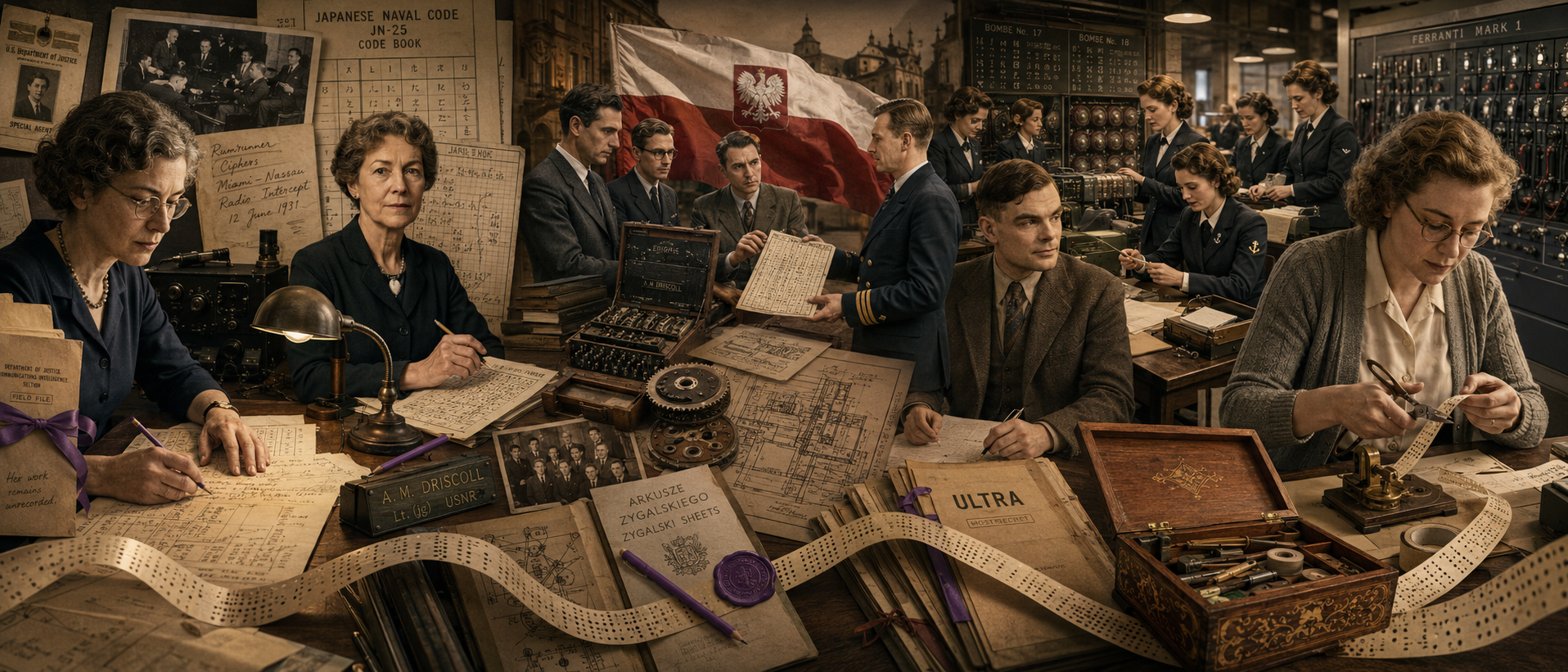
“The machines entered history. Too many of the people were written out of it.”
𝗢𝗰𝘁𝗲𝘁 𝘁𝗵𝗲 𝗦𝗲𝗰𝗼𝗻𝗱
I thought I knew what this set of eight articles would be about.
Machines. Ciphers. Intercepted messages. The gradual transformation of cryptography from a specialised craft into an organised profession.
I was wrong. It is about people.
Images in this article are generated by

EU AI Act Regulation 2024/1689
It is about Elizebeth Friedman reading the secrets of rumrunners and Nazi spies, only for institutions and men around her to inherit much of the credit.
It is about Agnes Meyer Driscoll breaking Japanese naval systems and training the officers history later chose to remember instead.
It is about Polish mathematicians, engineers and intelligence officers who cracked Enigma before the war, passed their work to Britain as invasion approached, and then watched their contribution fade behind a simpler national myth.
It is about thousands of women operating the machinery, preparing the records, checking the results and keeping the intelligence system alive while history photographed the machines and cropped them out.
It is about Alan Turing helping to save a country clever enough to use his mind, but not civilised enough to protect the man who possessed it.
And it ends with Joan Travis, a programmer in 1950s Manchester, physically repairing software with scissors, Sellotape and a small brass punch called a bodger. Even there, in the apparently modest history of the software patch, another woman’s technical work was waiting to be rediscovered.
This octet affected me greatly.
Some of these stories upset me. Some made me genuinely furious. Every one left me with a sense of what had been lost: lives shortened, names erased, credit displaced, knowledge hidden and human potential squandered by prejudice, secrecy and institutional convenience.
The technical achievements are extraordinary.
But the strongest lesson is not technical.
Security capability does not emerge from machines alone. It comes from people: mathematicians, linguists, engineers, operators, teachers, spies, maintainers and analysts. Some become famous. Many disappear into the institutions that used their work.
Remembering them is not decorative. It is part of understanding the capability itself.
The machine was broken.
The intelligence was protected.
Too often, the people were not.
This is Octet the Second of A History of Cybersecurity in 2⁷ Artefacts.
I expected it to explain how cryptography became machinery.
Instead, it showed me the human cost of deciding whose work counts as history.
THIS is the heart of the project.
Not merely a history of artefacts, but a restoration of provenance. A refusal to let the machinery eclipse the people who imagined it, built it, operated it, repaired it, risked their lives for it, and were then quietly removed from the official version.
That is why this octet hurts.
And why it matters.

II
Octet the second – Contents
Cryptography becomes machinery, intelligence and profession
| No | Date or Era | Artefact and Type | Title & Why? |
|---|---|---|---|
| 009 | 1917 | Vernam teleprinter cipher Machine cryptography | Gilbert Vernam’s paper tapes: When cryptography learns to type for itself Vernam’s teleprinter cipher mechanised encryption by combining message text with a key stream. It points towards stream ciphers, automated communications security and the modern habit of securing machines talking to machines. Cryptography has to become both operational and scalable. |
| 010 | 1917 to 1919 | One-time pad Cryptographic ideal | Perfect secrecy, paid for in advance The one-time pad gives perfect secrecy when its key material is truly random, as long as the key is used once, kept secret and is as long as the message. Those conditions are wildly inconvenient, which is why humans invented logistics and then complained about them. Its value is as the high-water mark against which practical cryptography is judged. |
| 011 | 1917 | Zimmermann Telegram Signals intelligence and diplomacy | The secret that needed a cover story The Zimmermann Telegram was an encrypted German diplomatic message proposing a Mexican alliance against the United States. British cryptanalysts recovered enough of its content to turn a secret cable into a strategic public event. Its significance is not only the cryptanalysis. It shows the whole intelligence lifecycle: interception, decryption, source protection, disclosure strategy and political effect. Modern cyber operations still face the same awkward question: when you know something secretly, how do you use it without burning how you know it? |
| 012 | 1920s to 1945 | Enigma Cryptographic system | Breaking the machine was only half the secret. And the smaller half by far Enigma made encryption electromechanical, portable and routine for military communications. Its defeat was not one magic trick: captured material, operator habits, procedural errors, traffic analysis, mathematics, machines and disciplined organisation all mattered. That is why Enigma belongs in a cybersecurity history rather than just a cryptography history. It shows that the security of a system includes training, workflow, key discipline, maintenance, configuration and the small human shortcuts that adversaries patiently collect. |
| 013 | 1920s to 1940s | Elizebeth Friedman’s rumrunner and spy ciphers Law-enforcement cryptanalysis | The woman who read everyone else’s secrets, then vanished from the story Elizebeth Smith Friedman broke thousands of encrypted messages used by rumrunners and smugglers, built cryptanalytic capability for the US Coast Guard and later worked against German espionage communications in South America. Her work shows cryptanalysis as law-enforcement tradecraft, not only as military codebreaking. She is an essential overlooked figure because much of her credit was displaced onto institutions and men around her. This artefact links cryptography to prosecution, expert testimony, intelligence analysis and the unpleasant human habit of forgetting who actually did the work. |
| 014 | 1920s to 1940s | Agnes Meyer Driscoll’s naval codebreaking Naval cryptanalysis | The woman who trained the men history remembered Agnes Meyer Driscoll, often called the First Lady of Naval Cryptology, attacked Japanese naval systems and trained many later US Navy cryptanalysts. She also pushed early machine assistance for cryptanalysis, which matters because scale was already becoming part of the problem. Her artefact is not one cipher but a professional lineage. Cybersecurity often worships single exploits; Driscoll represents deep skill, mentoring, continuity and institutional memory, which are less glamorous than a logoed vulnerability but far more useful. |
| 015 | 1932 to 1940 | Polish bomba, Zygalski sheets, and the British Bombe Cryptanalytic machinery | The head start that became a lifeline The Polish Cipher Bureau did not merely inspire later Enigma work; it gave Britain a running start. Marian Rejewski, Jerzy Rozycki and Henryk Zygalski turned Enigma into an engineering and mathematical problem, and Zygalski sheets and the bomba showed that machinery could be used to industrialise cryptanalysis. The later British Bombe, shaped by Alan Turing, Gordon Welchman and many others, scaled that idea inside a wartime intelligence factory. The artefact also opens the door to the often-hidden labour of women operators and clerical specialists who kept the machines, menus and punched records moving. |
| 016 | 1940s to 1960s | The software patch Maintenance concept | The small repair that became a permanent way of life Patching is a superbly literal term. Early programs on paper tape or punched cards could be corrected by covering, replacing or splicing the faulty part, and the word survived the move from physical media to code updates. Cybersecurity inherited the term and turned it into a permanent ritual: vulnerability appears, fix is issued, estate refuses to comply. Rinse, repeat ad nauseum. |

