
“Breaking the machine was only half the secret. And the smaller half by far”
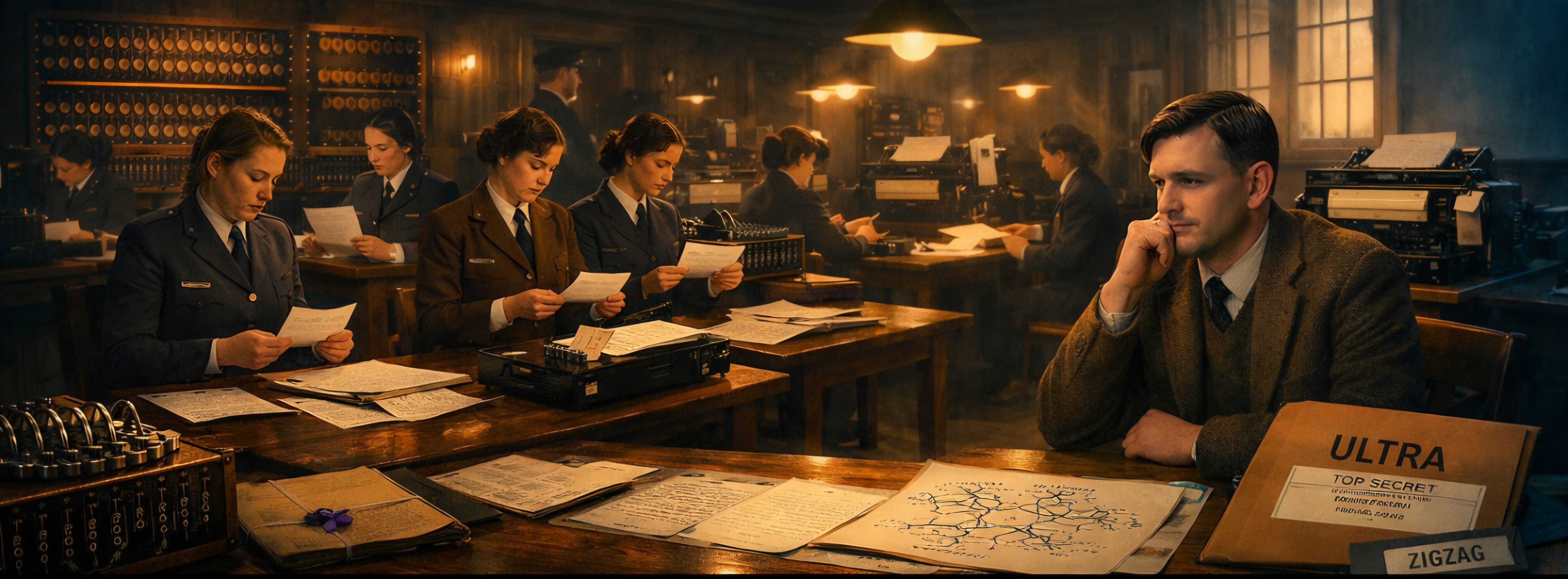
Enigma has suffered a peculiar fate.
It was designed to conceal information, yet it has become one of the most exposed machines in history. There are books about it, films about it, museum displays, replicas, software simulators and probably tasteful Enigma tea towels.
Images in this article are generated by

EU AI Act Regulation 2024/1689
Humanity has turned the workhorse of Nazi military cryptography into a gift-shop category.[1]
The familiar version of the story contains one machine, one impossible code, one socially awkward genius and one sudden moment of triumph.
The real story contains Polish mathematicians, French intelligence, British cryptanalysts, radio interception stations, captured documents, engineers, linguists, analysts, clerks, dispatch riders, Wrens, thousands of machine operators, secure communications links, operational commanders, double agents and an immense bureaucracy devoted to ensuring that the enemy did not notice just how comprehensively its secrets were leaking.
A machine did not break a machine.
A system broke a system.
Then another system had to make use of the result without revealing that the first system had succeeded.
That second problem is the one that interests us here.
A different substitution every time
Enigma looked rather like a typewriter placed inside a wooden box by someone who felt typewriters insufficiently ominous.
Pressing a key sent an electrical signal through a plugboard and a series of wired rotors. A letter illuminated on the lampboard, giving the encrypted character. At least one rotor moved with every keypress, so the electrical path changed and the same plaintext letter would normally be encrypted differently as the message progressed.
The receiving operator configured another Enigma machine identically and typed the ciphertext. The same mechanism recovered the original message.
The security did not depend merely upon possessing the machine. It depended upon rotor selection and order, rotor starting positions, plugboard connections and other settings distributed through keying instructions. The resulting number of possible configurations was vast. Enigma was fast enough for military use and sufficiently portable to spread across the German armed forces in enormous numbers.
But there was never one single Enigma system.
The Army, Air Force, Navy, intelligence services and other organisations used different procedures, keys and variants. Networks changed. Rotors changed. Operating rules changed. The German Navy eventually introduced a fourth rotor for U-boat traffic, temporarily blinding Allied cryptanalysis that had worked against the earlier version. “Enigma was broken” is therefore convenient shorthand for a prolonged and uneven campaign against many related systems, some readable on a particular day and others stubbornly dark.[2]
There was no permanent ceremonial moment when a large green lamp illuminated and somebody declared the entire Third Reich decrypted.
There were daily battles.
Before Britain, Poland
The Enigma story did not begin with Alan Turing, Bletchley Park or Britain.
Beginning in 1932, Polish mathematician Marian Rejewski applied permutation theory to the military Enigma and reconstructed its internal operation. Working with Jerzy Różycki and Henryk Zygalski, he developed techniques and machinery for recovering daily settings. Shortly before Germany invaded Poland, the Polish Cipher Bureau shared its achievements with British and French intelligence. Without that work, the British effort might never have got sufficiently far, sufficiently quickly.[3]
The Poles did not merely provide a hint.
They provided reconstructed machines, methods, knowledge of rotor wiring and years of intellectual work performed while Poland faced the increasingly obvious prospect of invasion.
Britain inherited a running start because Poland handed over the baton while the stadium was already catching fire.
Turing met Polish counterparts in January 1940 and used their insights as foundations for the British Bombe, developed with crucial improvements from Gordon Welchman and others. The Bombe did not simply try every possible Enigma setting. It tested candidate settings against logical constraints derived from a suspected piece of plaintext, known as a crib, rejecting enormous numbers of impossibilities quickly enough to make the daily problem tractable.[4]
Turing’s achievement was enormous.
It was not solitary.
Both statements can be true, despite the heroic-biography industry’s occasional difficulty processing more than one protagonist at a time.
We will return to the Polish contributions in more detail in Artefact 015, because they deserve proper exploration and recognition.
Bletchley Park was an industrial system
Bletchley Park is usually pictured as a country house full of eccentric mathematicians doing difficult things with pencils.
There were certainly difficult things and pencils.
But by the later war years, Bletchley Park and its outstations formed an industrial intelligence enterprise. Radio traffic first had to be intercepted by the Y Service. Operators listened across frequencies, copied Morse transmissions, identified call signs and communications patterns, took direction-finding bearings and forwarded the encrypted traffic for processing.
The ciphertext then had to be sorted by network and key, attacked cryptanalytically, tested through machinery, decrypted, translated, interpreted, compared with previous material and converted into intelligence suitable for decision-makers.
A message was not useful merely because somebody had turned it back into German.
Its significance had to be recognised.
A logistics report might reveal where a unit was moving. A weather transmission might expose a key-setting procedure. A request for fuel could disclose operational readiness. A repeated heading might provide a crib. A cluster of call signs could reveal an order of battle without a single message being read.
The breaking of Enigma was therefore not one act of genius. It was a production chain joining interception, mathematics, engineering, language, military knowledge, administration and judgement.
Cybersecurity has always been collective labour.
It merely prefers to put one man on the poster.
The women were the system
By 31 December 1944, Bletchley Park employed 6,760 women, representing 76% of its workforce. They served as cryptanalysts, linguists, traffic analysts, intercept operators, code clerks, slip readers, teleprinter operators, dispatch riders and machine operators. According to GCHQ’s own history, women were represented in every part of wartime signals intelligence except armed perimeter guarding and senior management, both of which remained exclusively male.[6]
A remarkably pure distillation of institutional life: women could operate the secret machinery helping to defeat Nazi Germany, but apparently the upper reaches of the organisational chart remained too technically demanding.
Wrens served at Y stations, intercepting and locating German signals before sending the encrypted traffic onwards. Others operated Bombes at Bletchley Park and remote sites such as Eastcote and Stanmore. The machines had to be configured, maintained, watched and checked continuously. When a Bombe stopped at a possible setting, an operator recorded it, tested it on checking equipment and sent a successful candidate back to Bletchley over a secure link.[7]
Jean Millar later recalled maintaining the Bombe’s electrical contacts, loading the machine, recording stops and passing successful results onwards. The machine generated noise, heat and possible settings. It did not generate its own workforce, whatever later accounts may imply.[8]
Women also performed the intellectually prestigious work that history has been slower to recognise.
Joan Clarke worked with Turing in Hut 8 against Naval Enigma and became highly skilled in Banburismus, the statistical method used to reduce the amount of Bombe processing needed. She remained in Hut 8 throughout the war and later worked for GCHQ for many years. She was not present to provide Turing with a suitably heterosexual romantic subplot. She was a cryptanalyst.[8]
Mavis Lever, later Mavis Batey, exploited poor operator behaviour in Italian and Abwehr Enigma traffic. Thousands of other women worked behind initials, service ranks and generic job titles, maintaining a secrecy they had been told might determine the outcome of the war.
Many went home afterwards and said nothing.
Some did not even discover the full meaning of their own work for decades.
The official secret survived partly because an enormous number of women were trusted with it and proved worthy of that trust.
History then thanked them by describing them as assistants.
From a decrypt to ULTRA
The decrypted messages and intelligence derived from high-grade enemy systems became known as ULTRA.
ULTRA was not synonymous with Enigma. It also included intelligence from other high-level cryptographic systems. Nor was it simply a pile of translated German messages sent directly to generals with the words “do something clever” written on top.
Material had to be assessed, combined and presented. At Bletchley, intelligence reports were edited and annotated before tightly controlled distribution to senior political and military recipients. Secure liaison and communications units carried the product to commanders without disclosing its technical origin more widely than necessary.[9]
This distinction matters.
A decrypted message is data.
ULTRA was a product.
It had provenance, confidence, context, handling restrictions, operational consequences and an adversary who must not discover why the Allies knew what they knew.
The British had created an intelligence capability of almost absurd value. If used recklessly, that very value could destroy it.
A convoy that miraculously avoided every U-boat concentration would eventually look less like fortunate navigation and more like somebody reading Admiral Dönitz’s correspondence.
A bomber intercepted precisely where a secret order said it would appear might cause the Luftwaffe to review the security of that order.
A German agent arrested immediately after landing might reasonably wonder how the reception committee knew which field to stand in.
Success could become an indicator of compromise.
The defender’s actions could leak the existence of the defender’s visibility.
Modern security operations teams know the same problem. Block every malicious action immediately and the attacker learns which behaviours are detected. Remove a compromised account too neatly and the adversary learns which access path has been discovered. Act on intelligence carelessly and the response becomes feedback to the intruder.
Observation changes behaviour.
Not only in quantum mechanics, where at least the particles do not convene a security review afterwards.
The security of knowing
Protecting ULTRA required several overlapping controls.
Distribution was severely restricted. Commanders receiving ULTRA-derived information often did not know the full technical route by which it had been obtained. Reports were sanitised. Secure liaison units controlled access. Intelligence might be supported by radar, direction finding, aerial reconnaissance, captured documents, agents or other sources that provided a plausible explanation for Allied action.
Sometimes the safest use of ULTRA was indirect.
Rather than sending warships to attack every U-boat revealed by decrypted traffic, convoys could be routed away from danger. Avoidance produced fewer dramatic victories, but it protected shipping while giving the Germans less reason to suspect that their operational messages were readable. US naval history records that this was a deliberate element of Allied strategy.[11]
Sometimes reconnaissance was sent to “discover” something already known from ULTRA. The aircraft was not always collecting new intelligence. It was creating an observable explanation for intelligence already held.
This is not waste.
It is source protection.
Sometimes action had to be delayed, limited or omitted because the gain did not justify the risk of exposing the capability.
That does not mean every Allied failure or unprevented tragedy was a deliberate sacrifice to protect Enigma. The enduring story that Churchill knowingly allowed Coventry to be destroyed for that reason is not supported by the evidence. Decrypts revealed that a major operation was coming, but the available intelligence did not identify Coventry decisively until the raid was already imminent; warnings, jamming, fighters and defensive preparations were attempted and proved inadequate.[12]
Reality is grim enough without improving it for television.
The genuine dilemma remains. Intelligence cannot save everyone. Intelligence may be incomplete, late, ambiguous or impossible to exploit safely. Protecting the source can affect how information is used, but it is not a convenient historical solvent into which every catastrophe may be dissolved.
Did the Germans suspect?
Yes.
That is not the same as understanding what had happened.
German security organisations investigated losses, unexpected Allied movements and apparent foreknowledge. Some officers considered the possibility that communications had been compromised. The German Naval Staff conducted inquiries after particularly successful Allied operations.
But suspicion repeatedly settled upon explanations such as spies, betrayal, captured material, radio direction finding, radar, traffic analysis, chance or insecure Allied-facing systems rather than a sustained conclusion that Enigma itself was being read systematically. One US Navy historical study records that a German inquiry following damaging operations concluded that British knowledge came from agents and happenstance rather than decryption, although not everybody involved was necessarily convinced.[13]
The concealment of ULTRA was therefore extraordinarily successful, but not magical.
The Germans were not uniformly oblivious. They changed procedures, introduced new rotors and keys, investigated security failures and periodically deprived Bletchley of access. When the four-rotor Naval Enigma appeared in February 1942, Allied reading of key U-boat traffic suffered a blackout lasting much of that year. Cryptanalytic success was reversible, because the adversary was allowed to make changes too. Most inconsiderate.[13]
Several factors protected the secret.
Allied actions rarely depended upon ULTRA alone. Radar, HF direction finding, captured material, reconnaissance, human agents and ordinary military analysis were real capabilities, not merely excuses. German organisations also suffered from compartmentation, rivalry and the understandable psychological difficulty of accepting that a system believed mathematically overwhelming had been compromised at industrial scale.
Most importantly, the Allies exercised restraint.
Not perfectly.
Not uniformly.
But sufficiently well that Germany continued to rely upon Enigma throughout the war without reaching the strategically correct conclusion: the machine, its procedures and the organisations using it had become a continuing Allied intelligence source.
The Nazis sometimes suspected leaks.
They did not diagnose the full haemorrhage.
Agent Zigzag: trusting the untrustworthy
Eddie Chapman was, by ordinary standards, not an obvious candidate for institutional trust.
He was a professional criminal, safe-breaker and fugitive who found himself in the occupied Channel Islands, volunteered to spy for Germany, received Abwehr training and was parachuted into Britain in December 1942 with orders to sabotage the De Havilland aircraft factory.
Double agents are inherently awkward assets. Their professional value lies in persuading one side that they are betraying the other, while their personal incentives may involve money, survival, ego, ideology or a flexible relationship with truth.
MI5 did not have to assess Chapman solely from what Chapman said.
British intelligence had already broken the relevant German communications. It knew that the Abwehr agent codenamed Fritzchen was coming, when he would arrive and what mission he had been given. When Chapman surrendered himself and described his training and orders, MI5 could compare his story against information obtained directly from the enemy’s supposedly secure messages.[14]
ULTRA did not make Chapman trustworthy.
It made his claims testable.
That is much better.
Chapman became Agent ZIGZAG. MI5 staged elaborate fake damage at the De Havilland factory, including timber-and-canvas destruction convincing enough to deceive German reconnaissance and some of the factory’s own staff. A false newspaper report helped complete the illusion. Chapman informed his German handlers that the sabotage had succeeded, and the delighted Abwehr later awarded him the Iron Cross.[14]
It is difficult not to admire the complete absurdity.
A British criminal pretended to become a German agent, genuinely became a British agent, conducted a fake German sabotage operation against a real British factory, convinced the Germans that he had destroyed it, and was decorated by Nazi Germany for damage largely constructed from wood, paint and papier-mâché.
Behind the theatricality sits a serious cybersecurity lesson.
When evaluating an untrusted source, independent telemetry matters.
Chapman’s statements were one evidence stream. German encrypted traffic was another. Physical observation, controlled communications and subsequent German reactions added more. Trust was not granted as a personality judgement. It was constructed through corroboration.
Zero Trust, but with an Iron Cross.
A mathematical correction
There is a tempting version of this story in which Alan Turing developed a mathematical method for deciding exactly how much ULTRA intelligence the Allies could safely use before Germany realised Enigma had been broken.
The balancing problem was real.
The neat mathematical method was not.
Turing and Jack Good developed ways to measure the weight of evidence for competing cryptanalytic hypotheses. Their units, bans and decibans, allowed observations to be accumulated and compared mathematically. Banburismus used Bayesian reasoning to judge likely relationships between Naval Enigma messages and reduce the number of machine tests required. Joan Clarke became one of its expert practitioners. (GCHQ)
This was a mathematical treatment of questions such as: How strongly does this evidence support one rotor arrangement over another?
It was not a formula answering: How many convoys may we reroute before Admiral Dönitz becomes suspicious?
There was no universal deciban allowance for conspicuously informed military success.
The operational use of ULTRA depended upon judgement, compartmentation, deception, alternative sources, military necessity and estimates of how the enemy would interpret events. The cryptanalysts quantified evidence. Intelligence and operational staffs managed exposure.
The distinction is important because the Enigma story already contains quite enough mythology without assigning Turing a wartime risk dashboard.
Alan Turing
Turing deserves his central place in this story.
He also deserves to be seen whole.
Before the war, he had helped define the mathematical meaning of computation. At Bletchley Park he led work against Naval Enigma, designed the British Bombe on foundations supplied by the Polish cryptanalysts, developed statistical methods with colleagues and later worked on secure speech systems.
After the war he produced the first detailed design for a stored-program computer in the Automatic Computing Engine project. At Manchester he contributed to early general-purpose computing, developed foundational ideas in artificial intelligence and proposed what became known as the Turing Test. He then turned towards mathematical biology and morphogenesis, asking how chemical processes could generate the patterns and structures of living organisms.[15]
This was not one brilliant contribution followed by a long period of ceremonial genius.
It was a mind repeatedly entering new fields and leaving foundational ideas behind.
Then, in 1952, the British state prosecuted him for a consensual relationship with another man.
He was offered prison or probation conditional upon hormonal treatment, called “chemical castration”[16] intended to suppress his sexuality. He chose the treatment. His security clearance was removed, cutting him off from secret work for the country whose survival he had helped to ensure. In June 1954, aged 41, he died from cyanide poisoning. The inquest returned a verdict of suicide, although aspects of the circumstances have continued to be debated.[17]
We should be precise here.
It is impossible to prove a simple, single causal chain from prosecution to death, and his life should not be reduced to a tidy tragedy any more than his wartime work should be reduced to a tidy triumph.
We do not need to exaggerate.
The established facts are appalling enough.
A society that owed Turing an almost unimaginable debt criminalised him, subjected him to medically imposed hormonal treatment, treated his sexuality as a security defect and removed him from work he was uniquely qualified to perform.
You’ll excuse me descending into technical jargon for once, but here it is both justified and necessary: it did this without the first fucking clue what else he might have given us.
The missing decades
Counterfactual history is dangerous. It is easy to turn a dead genius into a supernatural machine producing every invention one wishes had arrived earlier.
We cannot know what Turing would have achieved in his fifties, sixties, seventies or eighties.
But we can look at the trajectory interrupted at 41.
He had already changed mathematical logic.
He had already helped establish theoretical computer science.
He had already transformed cryptanalysis.
He had already designed secure communications equipment.
He had already contributed to stored-program computing.
He had already begun formal work on machine intelligence.
He had already crossed into mathematical biology, leaving extensive unfinished work on morphogenesis that colleagues later tried to organise and publish.[18]
We cannot name the discoveries that were lost.
That is exactly what makes the loss so large.
Perhaps he would have developed artificial intelligence further. Perhaps programming languages, verification, cryptography, complexity, neural computation or biological modelling. Perhaps he would have moved into fields not yet named. Perhaps he would simply have produced decades of smaller work, mentored others and corrected everybody’s assumptions in meetings.
The point is not that Turing would certainly have invented the future.
The point is that Britain deliberately deprived the future of Turing.
GCHQ’s later judgement is admirably plain: the cost of intolerance towards him was a loss to the nation.[19]
A pardon sixty years later cannot restore the missing work.
A banknote cannot contain the absent decades.
Apology is not atonement.
Protecting the product
Enigma is usually remembered as a story about confidentiality.
Its deeper lesson is about operational security after confidentiality has already failed.
The Germans believed their encrypted communications were protected. Many were not.
The Allies possessed the resulting intelligence. But possessing it created a new asset that required protection: the fact that the communications could be read.
The security objective therefore changed.
At first, the asset was the plaintext.
Then the asset became the capability to recover future plaintext.
That distinction appears everywhere in modern cybersecurity.
A vulnerability may be less valuable than continued access through it.
A malware implant may be protected even while its intelligence is used.
A fraud investigation may permit suspicious transactions to continue temporarily so the network can be mapped.
A threat-intelligence indicator may be withheld from broad distribution because publishing it would expose a source.
A security team may watch an attacker move rather than ejecting them immediately, because understanding the whole intrusion is worth more than closing the first observed session.
Every such decision is dangerous.
Delay creates exposure. Action creates exposure of another kind. Protect the capability too fiercely and people may be harmed while intelligence sits unused. Exploit it too enthusiastically and the adversary learns, adapts and closes the window.
There is no risk-free setting.
There is only judgement.
The real artefact
The artefact is not merely the Enigma machine.
It is the entire opposing pair of systems built around it.
On one side: machines, rotors, plugboards, key sheets, operators, radio networks, military procedures and the belief that combinatorial complexity guaranteed security.
On the other: Polish mathematics, captured materials, Y-station listeners, cribs, Bombes, Wrens, cryptanalysts, translators, traffic analysts, secure distribution, operational restraint, deception and thousands of people keeping a secret long after the war had ended.
The German cryptographic system failed not because Enigma was a silly machine.
It failed because security is really a function of the whole system.
The Allied intelligence system succeeded not merely because it could read messages.
It succeeded because it could turn them into action while concealing the ability to read the next ones.
That is the pinnacle.
Not breaking one ciphertext.
Not even breaking Enigma repeatedly.
Building an immense human and technical apparatus that extracted intelligence, assessed it, distributed it, corroborated it, acted upon it and protected its own continued existence.
The machine was broken.
ULTRA was protected.
Turing was not.
And a society clever enough to read the most guarded secrets of Nazi Germany proved itself stupid enough to persecute one of the people who had made that possible.
There is a lesson here too large to even state. But one which current society is in danger of missing. And that would be appalling. Again.

00001100 FF
References & Links
[2] https://www.history.navy.mil/news-and-events/news/2024/nhm-080624.html
[4] https://www.gchq.gov.uk/information/alan-turing
[5] https://www.gchq.gov.uk/information/centenary-womens-service-uk-armed-forces
[6] https://www.gchq.gov.uk/information/aguila-wrns
[7] https://www.gchq.gov.uk/information/international-womens-month-jean-millar
[8] https://www.gchq.gov.uk/information/joan-clarke
[10] https://www.gchq.gov.uk/information/how-codebreakers-helped-fight-battle-britain
[12] https://www.gchq.gov.uk/information/the-bombing-of-coventry-in-wwii
[14] https://www.mi5.gov.uk/history/world-war-ii/eddie-chapman-agent-zigzag
[15] https://www.gchq.gov.uk/information/alan-turing
[16] https://en.wikipedia.org/wiki/Chemical_castration
[17] https://www.gov.uk/government/news/royal-pardon-for-ww2-code-breaker-dr-alan-turing
[18] https://turingarchive.kings.cam.ac.uk/unpublished-manuscripts-and-drafts-amtc/amt-c-24to27

