
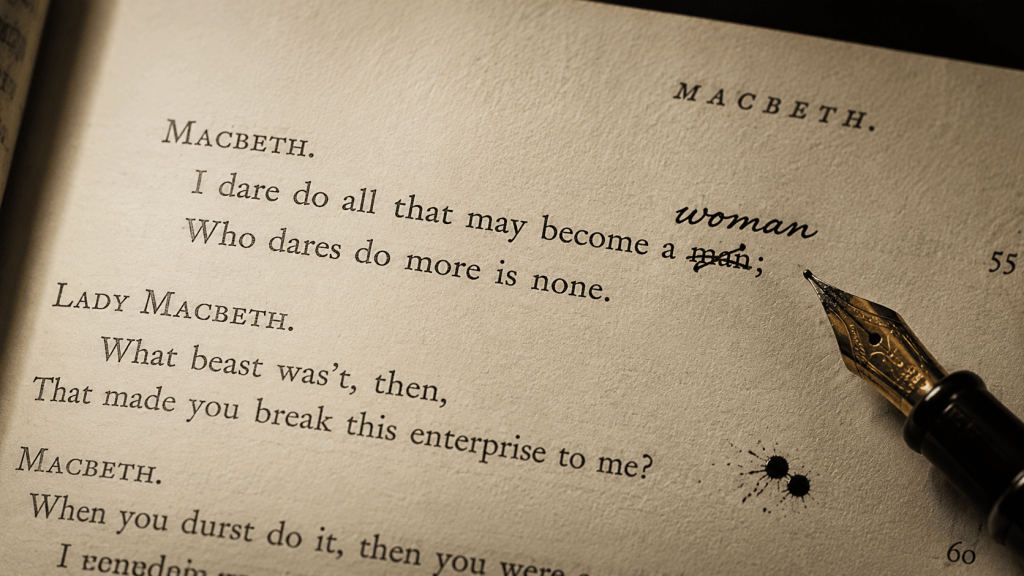
A tiny act of Shakespearean vandalism, and the unexpectedly large question it opens about gender, performance, and becoming.
One Word, and Everything Moves
I changed one word in Macbeth almost as a joke. Then I realised that the joke had teeth.
The original comes in Act 1, Scene 7. Lady Macbeth has been attacking Macbeth’s courage and, more specifically, his masculinity because he is recoiling from the murder of Duncan. Macbeth replies:
| “I dare do all that may become a man; Who dares do more is none.” |
| Macbeth, Act 1, Scene 7 |
In Shakespeare’s usage, “become” here means “befit” or “be appropriate to”. Macbeth is not claiming that he will do anything whatsoever to prove that he is a man. He is saying almost the opposite: he will do everything that properly becomes a man, but there is a point beyond which an act ceases to prove manhood and instead makes the actor less worthy of the name.
Change just one noun, though, and the sentence starts doing something Shakespeare could not have intended, but which modern English rather wonderfully permits:
| “I dare do all that may become a woman. Who dares do more is none.” |
One verb, two meanings
The word become now carries two perfectly grammatical readings at once.
First: that which becomes a woman: that which suits, befits, or is appropriate to her.
Second: that through which one may become a woman: becoming as transformation, discovery, emergence, or simply the process of recognising oneself more clearly.
The original verb has acquired another life in modern ears. Suddenly the line can mean not merely “I dare to do what is fitting for a woman”, but also “I dare to do what may allow me to become the woman I can be”.
And then there is “dare”. In the altered line, daring is no longer only about courage in action. It can also be the courage involved in self-examination, experimentation, disclosure, transition, presentation, or simply admitting that a possibility exists.
Not “pretend to be”. Not “dress as”. Not “qualify as”. Become.
And what of the second line?
In Macbeth, the second line is a refusal of Lady Macbeth’s attempt to weaponise masculinity. Her argument is effectively: if you were really a man, you would do this terrible thing. Macbeth’s reply is that her definition of manhood is wrong. There are things a man should refuse to do precisely because he is a man.
Once the first line has been changed, however, the second can acquire a different modern resonance. It can be read as a rejection of the endless demand for proof.
- You do not have to perform femininity harder to make it real.
- You do not have to pass somebody else’s checklist of clothes, voice, mannerisms, relationships, medical treatment, or transition milestones.
- You do not have to suffer more in order for your experience to count.
- You do not need an additional ordeal to legitimise womanhood.
That is not what Shakespeare meant, of course. It is what the changed wording allows a modern reader to hear. The distinction matters.
| This is not an argument that Shakespeare secretly wrote a twenty-first-century gender manifesto. He did not. It is a modern reading produced by a changed noun, the multiple meanings of “become”, the theatrical history of the plays, and the reader bringing a modern life to an old text. |
The theatrical irony
There is then the additional historical joke, and it is a very good one.
On the professional public stage in Shakespeare’s England, female roles were normally played by boys or young men. Lady Macbeth, Juliet, Rosalind, Ophelia, and the rest were therefore originally embodied by male performers. Women did perform in other theatrical or courtly contexts, but they did not become professional actors on the English public stage until the Restoration (circa 1660).
So consider the layers. A male playwright writes Lady Macbeth. Lady Macbeth is originally played by a boy or young man. She attacks Macbeth by challenging whether he is sufficiently masculine. Macbeth rejects her definition of manhood. Four centuries later, one noun is changed, and the resulting line can be read as a reflection on becoming a woman.
The first professional audiences were already participating in an agreed act of gendered theatrical imagination. They knew that the woman before them on stage was being played by a male actor, and yet for the purposes of the drama she was Lady Macbeth. Theatre has always understood something that everyday argument occasionally forgets: presentation, embodiment, role, identity, and truth do not sit in simple one-to-one relationships.
Lady Macbeth herself
And Lady Macbeth was hardly uncomplicated about gender herself. Earlier in the play, Lady Macbeth asks the spirits to “unsex me here”, wanting to be stripped of qualities her society associates with femininity so that she can pursue power and violence without pity. Soon afterwards she tells Macbeth that when he dared to pursue the murder, “then you were a man”.
The play is therefore already interested in gender as expectation and leverage: what men are supposed to dare, what women are supposed to feel, which characteristics a society codes as masculine or feminine, and how those expectations can be used to manipulate people.
Again, none of this makes Shakespeare a modern gender theorist. It makes him a dramatist fascinated by power, identity, performance, self-conception, and the stories people tell themselves about what sort of person they are. Those subjects have aged rather well.
Performance is not always pretence
There is a final reason the theatrical history appeals to me. We often use “performance” as though it means falseness: if something is performed, perhaps it is not authentic. But ordinary identity is performed constantly.
We express ourselves through clothes, names, voices, gestures, manners, occupations, social roles, and the thousand small choices through which other people encounter us.
Gender has its performances too. Sometimes performance conceals. Sometimes it protects. Sometimes it experiments. And sometimes it reveals something that was already there but had not previously been given room to appear.
The interesting question is therefore not simply whether somebody is performing, because everybody is. It is whether the performance is imposed upon them, used as armour, explored tentatively, or experienced as a more truthful way of being.
Becoming
That is why this faux quotation has stayed with me. It began as a tiny piece of Shakespearean mischief. It turned out to contain rather more than I expected.
One changed noun turns an argument about masculinity into an ambiguity about femininity. One old verb suddenly means both what befits a woman and what may allow a woman to emerge. The history of Shakespearean performance adds a further layer in which gender was visibly and knowingly enacted from the beginning.
And the second line, at least in this modern reading, refuses the demand for ever greater proof. There need not always be one more test, one more threshold, or one more act that finally makes a person sufficiently legitimate in somebody else’s eyes.
| “I dare do all that may become a woman. Who dares do more is none.” |
Rather a lot to hide inside thirteen words. Shakespeare remains, annoyingly, very good at this.

Sources and a textual note
Macbeth, Act 1, Scene 7 (Folger Shakespeare Library): Folger text
On women and female roles on Shakespeare’s stage: Royal Shakespeare Company; Shakespeare’s Globe
Textual note: modern editions including Folger print “Who dares do more is none.” The 1623 First Folio prints “Who dares no more, is none”, a well-known textual problem that modern editors commonly emend. The modern Folger reading is used throughout this article.

