
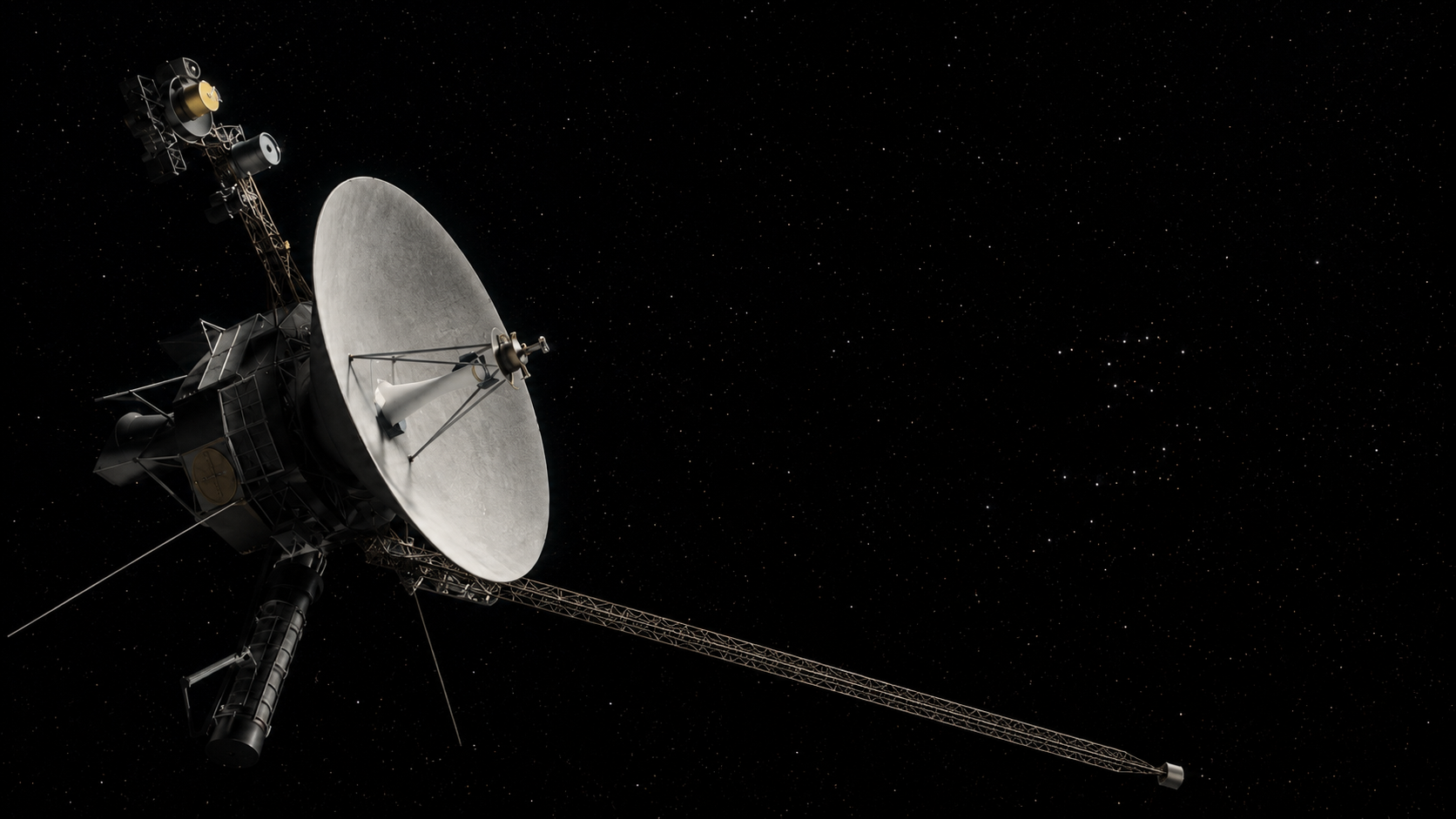
Image: Voyager 1 against the starry void. Fans of late 1970s / early 1980s BBC SciFi should look carefully. Bonus points for spotting the reference.
At 10:16 GMT/UTC on Wednesday 18 November 2026, Voyager 1 becomes the first human-made object one light-day from Earth.
That sounds simple enough, until you stop and let it settle.
One light-day.
Not one day’s travel by rocket. Not one day’s drive, or one day’s flight, or one day’s optimistic journey on Britain’s rail network. One day at the speed of light. A radio signal sent from Earth will take about twenty-four hours to reach Voyager 1. Its reply, if all goes well, will take another twenty-four hours to come back.
A conversation with Voyager is no longer really a conversation. It is correspondence with a tiny, stubborn ghost.
I have been thinking about Voyager for almost as long as I have been thinking seriously about space. In 1977 I was nine years old, listening to the news as Robert, long before Sophie had much room to exist in the open. I remember hearing about the Voyager launches and being puzzled by one detail that seemed immediately offensive to basic arithmetic: Voyager 2 launched first, in August, and Voyager 1 launched second, in September.
Even at nine, I knew that numbers were supposed to behave themselves.
The explanation, of course, was that the numbering was not about launch order. Voyager 1 was sent on a faster path and would reach Jupiter and Saturn first. Voyager 2, despite leaving Earth earlier, took the longer road. It was the slower sibling, the one with the more complicated itinerary, and in the end the one that would go on to visit Uranus and Neptune as well.
That little childhood puzzle has stayed with me. So has the sense that those launches were not just another news item. They felt like the future departing Earth on pillars of fire.
Nearly half a century later, the future is still leaving.
Voyager 1 is now so far away that its distance has become a unit of emotion. We can say “about 25.9 billion kilometres”, and that is accurate, but it is also too large to hold in the mind. We can say “about 173 times the Earth-Sun distance”, which is better for astronomers and worse for everyone else. But “one light-day” has a particular force. It tells us not just how far away Voyager is, but how long the universe makes us wait.
At one light-day, a command sent today arrives tomorrow. A reply arrives the day after. Engineers do not steer Voyager in any ordinary sense. They compose instructions, transmit them into the dark, and wait. Every command is a small act of trust. Every response is a delayed reassurance from a machine built when disco was newly fashionable and computers were still large, almost exclusively beige, and socially awkward.
It is difficult not to feel something for it.
Voyager 1 is not alive, despite our lazy habit of treating old machines as though they have personalities. It does not know it is alone. It does not miss us. It does not look back. But we look after it, and we look out for it, and perhaps that is enough to make the feeling real on our side.
A rare chance, almost missed
The Voyager missions were made possible by one of those pieces of celestial timing that sounds like it was written by a novelist who had lost patience with subtlety.
In the 1960s, Gary Flandro, then working at NASA’s Jet Propulsion Laboratory, recognised that the outer planets would soon be arranged in a way that could allow a spacecraft to visit several of them in sequence. Jupiter, Saturn, Uranus and Neptune would be positioned so that a probe could use one planet’s gravity to bend its path and gain speed towards the next. This was the basis of the “Grand Tour”.
The opportunity was rare. Not once in a decade. Not once in a human career. Roughly once every 175 years. For the engineers and scientists of the 1960s and 1970s, it was effectively now or never; miss it, and nobody involved would get another opportunity. The Voyagers took their chance in 1977.
This is one of the most beautiful things about the Voyager story. It is not just a story of technology. It is a story of noticing. The planets were going to do what planets do, moving along their ancient paths without the slightest interest in NASA’s budget cycles. The opportunity existed whether anyone saw it or not. Someone had to recognise that the geometry of the Solar System had briefly become an invitation.
And then, absurdly, humanity had to do the rest.
That meant building spacecraft robust enough to survive years in deep space, smart enough to cope with faults, precise enough to hit moving targets across billions of kilometres, and frugal enough to operate on limited power. It meant designing instruments, cameras, radio systems, power sources, computers and command procedures. It meant navigating not just through space, but through politics, budgets, ambition, caution and the ever-present human tendency to turn good ideas into committee-shaped porridge.
The original Grand Tour concept was too expensive. It was scaled back. The official mission became a Jupiter-Saturn mission. But the spacecraft and trajectories preserved enough of the dream that, if the machines survived, if the encounters worked, if the funding continued, if nothing important broke at the wrong moment, the journey might go on.
That is a lot of ifs.
In 1977, the Voyagers left Earth when home computers were just beginning to appear, and before the web, smartphones, GPS-as-everyday-life, and most of the digital world we now pretend to understand.
In maybe the most extraordinary feat of TV shot timing ever, James Burke used the launch of Voyager 2 on 20 August 1977 to great effect as part of the James Burke’s Connections series (the linked video was shown in 1978) which firmly captured my imagination at the time.
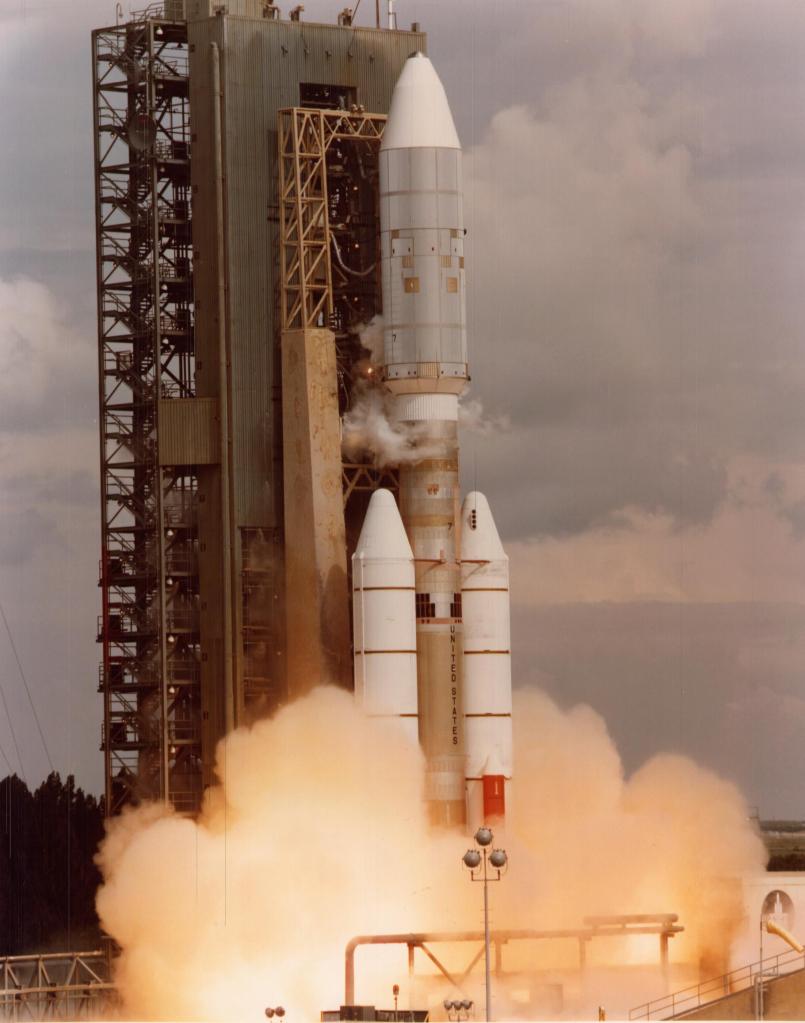
Voyager 1 flew past Jupiter and Saturn, then took a path shaped by the scientific prize of Titan, Saturn’s largest moon. Voyager 2 took the longer road and went on to Uranus and Neptune, giving humanity its only close-up encounters with those worlds so far.
The Grand Tour was not fully born in its original planned form, but it survived in practice. Like many worthwhile human achievements, it arrived slightly compromised, underfunded, renamed, and somehow magnificent anyway.
How to steal speed from a planet
The trick that made the Voyager journeys possible is the gravitational assist, often called a slingshot.
The word “slingshot” is helpful, but also a little misleading. There is no elastic band in space. A spacecraft approaches a planet, falls into its gravitational field, curves around it, and departs in a different direction. In the planet’s own frame of reference, the spacecraft may leave with roughly the same speed it arrived with, just redirected. But in the Sun’s frame of reference, because the planet itself is moving around the Sun, the spacecraft can gain speed.
It is an exchange of momentum.
The spacecraft steals an almost unimaginably tiny amount of the planet’s orbital energy. The planet slows by an amount so small it is ridiculous to contemplate. Jupiter does not notice. Saturn does not file a complaint. But the spacecraft notices very much indeed.
This is one of those pieces of physics that feels like cheating until you understand it, and then feels even more like cheating, but with better excuses.
Without gravitational assists, a mission to the outer planets would have required far more fuel, larger rockets, longer flight times, or all of the above. With them, Voyager could move from world to world, using the Solar System itself as part of the propulsion system. The planets became stepping stones, but stepping stones travelling at kilometres per second.
For non-specialists, the important idea is simple: Voyager did not carry enough fuel to fly directly from planet to planet like a spacecraft in a space opera. It used gravity and timing. It surfed the moving architecture of the Solar System.
For engineers and physicists, that is part of the enduring pleasure. Voyager was not just a brute-force mission. It was elegant. It was celestial mechanics turned into hardware. It was mathematics with a launch vehicle attached.
The worlds Voyager revealed
Before Voyager, the outer planets were known, studied and photographed, but they were still remote in a way that now feels hard to recover. They were not blank, exactly, but they were distant, blurred, half-imagined places. Voyager changed that.
Jupiter became a system of worlds. Its clouds were not just bands, but vast moving structures. Its moons became characters in their own right. Io, in one of the great surprises of planetary science, turned out to be volcanically active. Europa became more intriguing, a world with hints that would later feed one of the great scientific questions of our time: could there be an ocean beneath its ice?
Saturn’s rings, already beautiful from Earth, became intricate. They had structure, divisions, braids, waves and puzzles. Titan, hidden beneath its thick atmosphere, became irresistible. Voyager 1’s path was chosen partly to give Titan the attention it deserved, even though that choice meant Voyager 1 would not continue on to Uranus and Neptune.
Voyager 2 did continue. It visited Uranus in 1986 and Neptune in 1989. Those encounters remain unique. Every close-up image we have from those planets came from that one spacecraft, passing through, doing its work, and leaving forever.
That is one of the strange emotional facts about flyby missions. They are brief by design. Years of planning lead to hours of closest encounter. The spacecraft does not stop. It cannot linger. It arrives, looks, measures, transmits, and is gone.
A flyby is not a visit. It is a glance. Voyager’s glances changed planetary science.
A 1970s machine in the deep
There is another reason Voyager remains so compelling: it is old.
Not historically old, like Stonehenge or the Antikythera mechanism. Technologically old, which is somehow more startling. Voyager was built in the age before smartphones, before the public internet, before laptops, before GPS became ordinary, before children grew up assuming that every rectangle of glass was secretly a portal to all human knowledge and several varieties of nonsense.
Your phone has vastly more computing power than Voyager. Your washing machine may have more computing power than Voyager. Your car almost certainly does, unless it is old enough to have a personality and an oil leak.
And yet Voyager is still out there, still communicating, still doing science.
This is where modern comparisons become both amusing and unfair. Yes, Voyager’s computers are primitive by current standards. Yes, its data rates are tiny. Yes, its systems are constrained in ways that would make a modern software developer weep artisan coffee. But Voyager was built to survive. It was designed with redundancy, caution and discipline. Real, solid engineering. It was tested for a journey from which no repair crew would ever return.
That last part matters.
If Voyager fails, there is no touching it. There is only diagnosis across billions of kilometres, commands sent into the dark, and a wait long enough to make impatience meaningless. On 18 April 2024, engineers sent Voyager 1 a command to move part of its flight software out of damaged memory. On 20 April, for the first time in five months, readable engineering data came home.
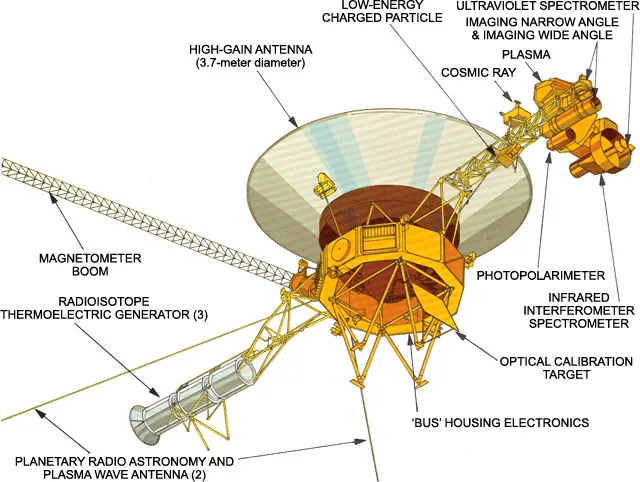
The spacecraft’s power comes from radioisotope thermoelectric generators, which convert heat from radioactive decay into electricity. They have been fading for decades, as expected. NASA’s engineers have had to shut down heaters, instruments and systems to preserve power for as long as possible. Each saving is a compromise. Each instrument turned off is one less sense available to the spacecraft.
It is a slow dimming, not a dramatic death.
This is not the sleek futurism of science fiction. It is something better: old engineering, carefully husbanded, still useful long after any reasonable warranty would have fled the scene.
The edge of the Sun’s kingdom
Voyager 1 crossed the heliopause in 2012. Voyager 2 followed in 2018. The heliopause is the boundary where the solar wind, the stream of charged particles flowing out from the Sun, gives way to the interstellar medium. It is often described as the edge of the Solar System, though that phrase needs careful handling.
The planets, dwarf planets and Kuiper Belt objects orbit well within the Sun’s gravitational domain, and the Oort Cloud may extend vastly farther out. Gravity does not simply stop at the heliopause. But the heliopause marks a real environmental boundary: the place where the Sun’s bubble in the galaxy ends.
Voyager 1 is now in interstellar space in that sense. It is sampling the medium between stars. It has not reached another star. It is not remotely close to doing so. But it has left the protective bubble blown by our Sun.
That is astonishing.
It is also a useful reminder that words like “interstellar” can mislead us if we are not careful. Interstellar space begins long before another star is nearby. Crossing into it is like leaving the harbour, not arriving at another continent.
Voyager has crossed the harbour wall. The ocean remains.
One light-day, and the cruelty of scale
This is where Voyager becomes both triumphant and humbling.
A light-day is enormous. Light travels about 300,000 kilometres every second. Light takes about 1.3 seconds to reach the Moon. To reach Voyager 1, it takes a day. In one day it travels about 25.9 billion kilometres. For Voyager 1 to reach that distance from Earth is a staggering human achievement.
And yet, by the standards of interstellar travel, one light-day is tiny.
Alpha Centauri, the nearest star system to our own, is about 4.3 light-years away. That is roughly 1,570 light-days. Voyager has taken nearly half a century to reach one light-day from Earth. It is not heading for Alpha Centauri, but even if it were, the comparison is brutal. At Voyager-like speeds, the nearest stars are not years away. They are tens of thousands of years away.
That is the uncomfortable poetry of this milestone. Voyager is impossibly far away and barely started.
This does not diminish it. Quite the opposite. It tells us what the achievement really is. Voyager is not proof that star travel is easy. It is proof that the first step is hard, slow, delicate, and worth taking anyway.
There is a childish version of space travel in which the stars are simply “out there”, waiting for us to invent a better engine and arrive with heroic music. Voyager teaches a sterner lesson. The stars are not nearby. They are not just across a border. They are across an abyss so large that even light has to settle in for the journey.
This is why the phrase “one light-day” matters. It converts distance into waiting. It lets us feel scale as delay.
When Voyager is one light-day away, Earth and machine will be separated by a day of light, two days for a reply, and almost fifty years of history.
A spacecraft as a time capsule
Voyager carries the famous Golden Record, a selection of sounds and images intended to represent Earth to any intelligence that might one day find it. The odds of that happening are spectacularly small, but the gesture is beautiful. It says something revealing about us that we sent a message even into near-certain silence.
But Voyager itself is also a time capsule.
It contains the ambitions of the 1970s. It contains Cold War-era science, post-Apollo engineering confidence, planetary curiosity, and a kind of institutional patience that feels almost exotic now. It belongs to a world of slide rules and mainframes, but it is still speaking to a world of cloud computing and machine learning.
The child who heard about its launch has grown older. The world has become stranger, louder, more connected and in many ways less wise. We have put the internet in everyone’s pocket and then looked surprised when civilisation began chewing the furniture. We have built wonders and distractions in roughly equal measure.
Voyager has simply kept going.
That constancy is part of its appeal. It does not care about fashion, politics, culture wars or the daily emotional collapse of social media. It is a tiny machine moving through the dark, doing what it can with what power remains.
There is something beautifully outrageous about that: a 1970s spacecraft, wrapped in thermal blankets rather than sequins, crossing the edge of the Sun’s influence with more dignity than most of humanity manages before breakfast.
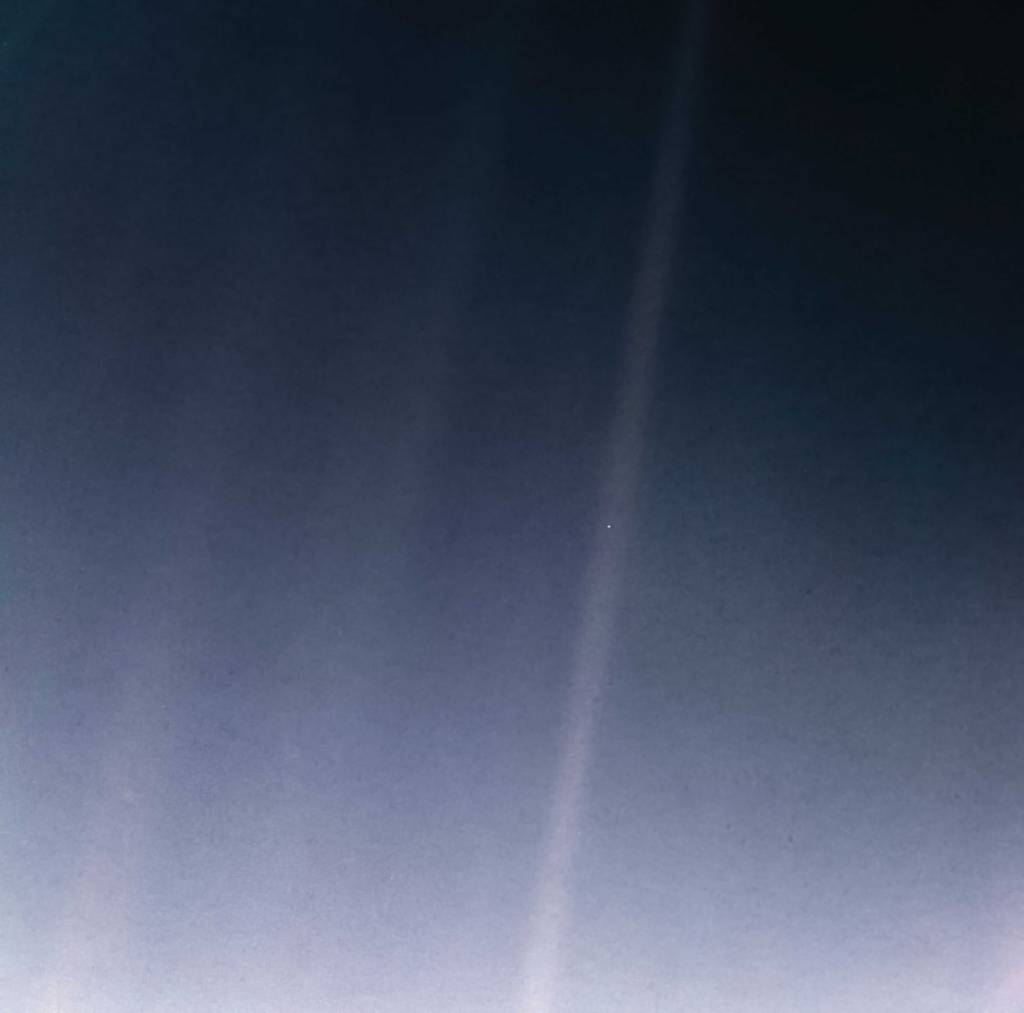
Voyager 1’s Pale Blue Dot image is not spectacular in the usual astronomical sense. There are no swirling galaxies, no glittering nebulae, no heroic planetary close-up. Earth is almost nothing: a tiny point of light caught in a scattered ray of sunlight, seen from billions of kilometres away. That is precisely why it matters. Every human life, argument, kindness, cruelty, invention, loss, love, war, poem, child, city and memory was on that dot. Voyager had already completed its planetary mission when it turned back for this final family portrait of the Solar System. The result is one of the most humbling images ever made: not because it shows how grand Earth is, but because it shows how small, fragile and precious it has always been.
The long goodbye
One day, Voyager 1 will fall silent.
Not dramatically. There will be no explosion, no final cinematic flare, no noble last words. The power will decline. Instruments will be switched off. The transmitter will eventually fail, or there will no longer be enough energy to run it. Perhaps a command will go unanswered. Perhaps engineers will listen and hear nothing but the ordinary noise of the universe.
After that, Voyager will continue.
This is another strange part of the story. The mission will end, but the journey will not. Without power, without communication, without awareness, the spacecraft will coast through the galaxy. It will become an artefact rather than a probe. A relic of a small blue world that briefly learned enough physics to throw metal beyond the Sun’s wind.
That future silence gives the present signals more weight. Every bit received now is precious, not because Voyager is young and capable, but because it is old and fading. Its survival is not guaranteed. It is being extended by care, ingenuity and the refusal of engineers to leave a working machine alone merely because it is inconveniently located beyond imagination.
At one light-day, that care becomes even more poignant. The people operating Voyager must live with delay as a basic condition. They send. They wait. They interpret. They adapt. It is engineering as patience.
Voyager suggests that some of our best work comes when we think beyond immediate reward. The mission was planned across years, executed across decades, and now speaks across a day of light. It was not built for quick applause. It was built to endure.
What Voyager means now
For me, the November 2026 milestone folds time back on itself.
I think of that nine-year-old in 1977, listening to the news and wondering why Voyager 2 had gone first. I think of the adults who built the spacecraft, many of whom are no longer here. I think of the planetary alignment that came just in time, the calculations that recognised it, the launch windows that could not be missed. I think of Jupiter’s storms, Saturn’s rings, Uranus’s tilted strangeness, Neptune’s blue distance.
And I think of one light-day.
It is a ridiculous distance. It is a tiny distance. It is both.
That is the truth Voyager offers us. Space is not scaled for human comfort. It does not care about our metaphors, our lifetimes, our budgets, or our impatience. The Solar System alone is vast enough to humble us. The stars are farther still.
But humility is not defeat. It is calibration.
Voyager 1 has not made the stars seem close. It has made the first step visible. It has shown that a machine built by human hands can cross the outer planets, pass beyond the Sun’s protective bubble, and keep whispering home almost fifty years later. It has shown that intelligence, timing and persistence can turn a rare planetary alignment into a journey no previous human artefact had made.
When I was nine, Voyager sounded like the future leaving Earth. Nearly half a century later, it is still leaving. It is one day away at the speed of light, a lifetime away at the speed of memory, and still only at the first chalk mark on the road to the stars.
And sometimes, if we are clever and lucky and just in time, we get to throw a small bright thing into the dark and hear it whisper back.


