
“The Computer Britain Pretended It Had Never Built”
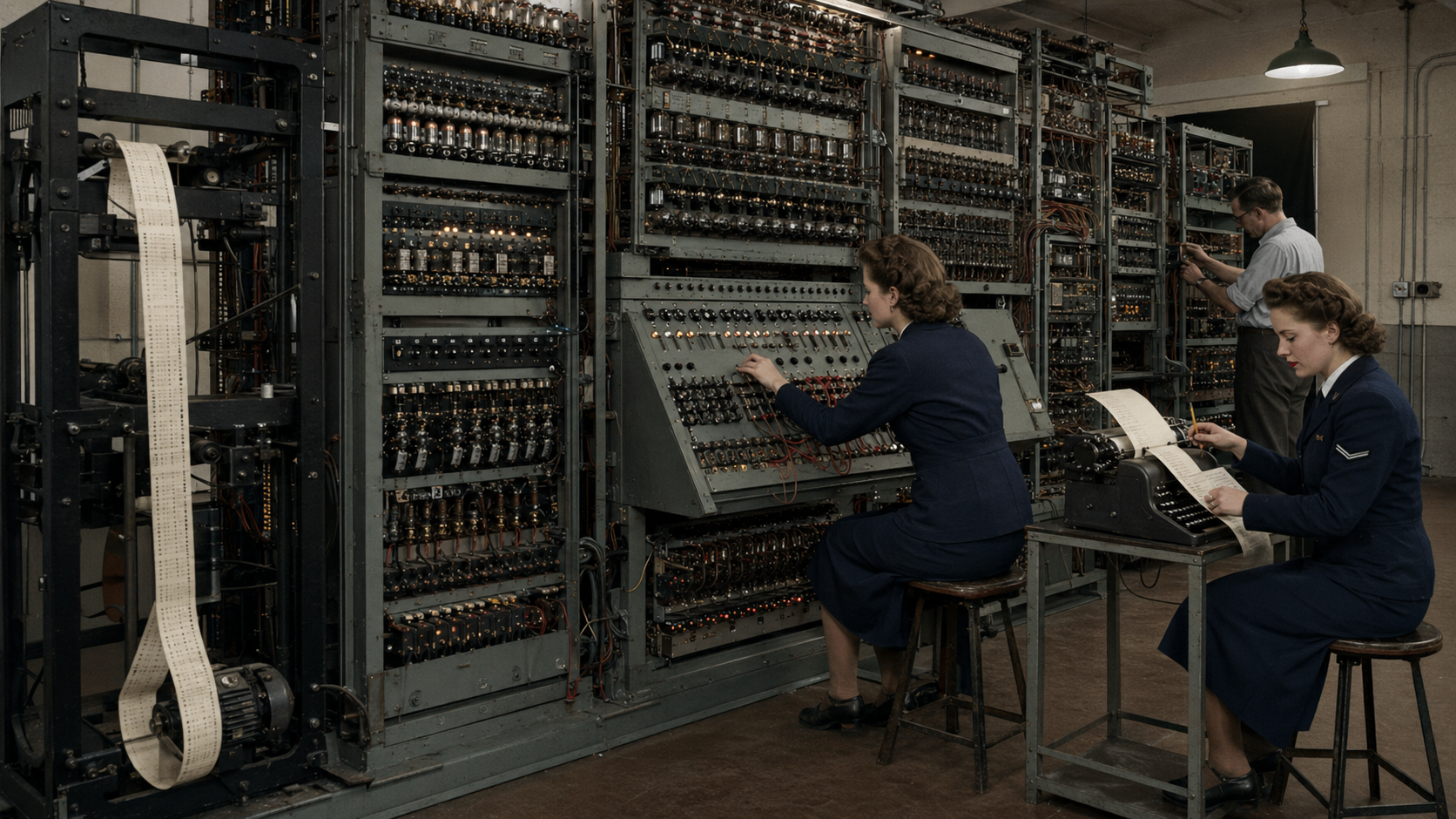
Colossus was not a general-purpose computer, did not break Enigma, and did not decode messages by magic.
It did something more interesting: it made one ferociously repetitive piece of cryptanalysis electronic, programmable, and fast.
Images in this article are generated by

EU AI Act Regulation 2024/1689
A strip of punched paper flew around a steel frame at thirty miles an hour (48 kph). Photoelectric cells read five rows of holes. Racks of valves generated other streams of bits, logic circuits compared them, counters accumulated statistical results, and an electric typewriter reported the candidates worth a human being’s attention. The machine stood more than two metres high, consumed roughly eight kilowatts, and contained about 2,500 valves in its Mark II form. It was called Colossus.[1][2]
There was no screen, no keyboard for writing programs, no stored program, and no attempt to be useful for every sort of calculation. Its ‘software’ was a configuration of switches, plugs, wheel patterns, and operator instructions. Yet it was electronic, digital, and programmable. In the careful formulation, Colossus was the world’s first programmable electronic digital computer.[2][9]
It was also SECRET. Not discreet, commercially confidential, or omitted from a press release: SECRET under the Official Secrets Act[14], with most of the machines dismantled, much of the documentation surrendered or destroyed, and the people who built, programmed, operated, maintained, and used it forbidden to explain what they had done.[1][8] For decades, histories of computing started elsewhere because Britain had deliberately removed one of their opening chapters.
Before opening that particular locked door, however, let us remove two famous men who are forever wandering into the wrong room. Colossus did not attack Enigma. It attacked Lorenz, the cipher Bletchley Park called Tunny. Alan Turing did not design it. Max Newman framed the machine problem, Bill Tutte made the decisive cryptanalytic breakthrough, Tommy Flowers designed the electronic answer, Ralph Tester’s section turned settings into readable intelligence, Post Office engineers made the hardware real, interceptors supplied the traffic, and women of the Women’s Royal Naval Service operated the machines around the clock. [2][3][4] This is not one-genius history. Colossus was a system made of people, mathematics, radio, paper, valves, discipline, and trust.
| TOMMY FLOWERS (1905-12-22 – 1998-10-28) I was lucky enough to meet Tommy Flowers over several weeks under some rather unusual and unlikely circumstances. Many people get described as “larger than life”. A few actually are, and Tommy most definitely was. |
Tunny without a Tunny
Lorenz SZ40 and SZ42 machines protected high-level German teleprinter traffic: long messages between headquarters, commanders, and occupied Europe rather than the shorter tactical traffic commonly associated with Enigma. A teleprinter represented each character as five binary impulses. Lorenz combined those impulses with a changing five-bit key stream, using the operation now called exclusive OR. Apply the same key stream again, and the plaintext returns.[2][4]
The key stream came from twelve pin wheels. Five chi wheels advanced regularly, five psi wheels advanced irregularly, and two motor wheels controlled that irregular movement. The starting positions changed from message to message. The possibilities were far too numerous for a clerk to try one after another, and Bletchley Park initially had no captured Lorenz machine to examine.[2][4]
Then, in August 1941, a German operator made the sort of mistake on which cryptanalytic history turns. A long message had to be retransmitted with the same machine settings, but the wording was not repeated exactly. Two different plaintexts had therefore been combined with the same key stream; a ‘depth’. John Tiltman used the pair to recover much of the plaintext and key. Bill Tutte then spent months studying the key’s structure and deduced how the unseen machine’s wheels worked.[3][10]
Tutte reconstructed the logic of a machine he had never seen from the shadow it cast in intercepted traffic. It remains one of the great intellectual achievements of the war. It also began with operator procedure. The Lorenz design was formidable; key reuse punched a human-sized hole through it. Think about the immensity of that task, and how such a small operational error gave him just enough information to rip into the system and find the weaknesses.
| A perfect cipher machine operated imperfectly is an imperfect cipher system. |
A machine for a probability
Knowing the structure did not make every message easy. The Testery, led by Ralph Tester, could solve Tunny traffic by hand, but the work was slow, exhausting, and dependent upon scarce expertise. Max Newman saw that part of the attack was not inspired guessing so much as repeated statistical measurement. If a machine could test candidate wheel relationships fast enough, it could hand the humans a much smaller pile of promising answers.[3][4]
The first automation, Heath Robinson, ran two punched-paper loops in synchronism: one carrying the intercepted message and one carrying a wheel pattern. At high speed, paper stretches, slips, tears, and develops opinions. Keeping two loops aligned proved the weakness. Tommy Flowers, a Post Office telephone engineer from Dollis Hill, proposed eliminating the second tape. Electronic circuits would generate the wheel stream internally. Only the intercepted message had to move.[2][6]
The proposal was radical because it used roughly 1,500 thermionic valves in the first machine. Valves were widely considered too unreliable in such numbers. But Flowers knew from telephone exchanges that much failure occurred during heating and cooling; leave well-designed equipment powered continuously, and reliability improved dramatically. The mathematicians were entitled to be nervous. The telephone engineer was entitled to know his components. [6]
| AN IMPORTANT LESSON Expertise, by its nature, tends to be specialist and domain-specific. We need to respect the specialist skills of others and not be too quick to dismiss them, otherwise we might miss the vital element that can achieve our objectives. |
Flowers and his Dollis Hill team (including Sidney Broadhurst, William Chandler, Allen Coombs, Harry Fensom, and Don Horwood) built the first Colossus in about eleven months. It arrived at Bletchley Park late in 1943, was assembled there, and attacked its first message on 5 February 1944. The faster Mark II followed in time for the D-Day period. [2][3][8]
The revolutionary move was not simply replacing labour with machinery. It was deciding exactly which part of thought could be made repetitive without pretending that the rest had vanished.
What Colossus actually did
Colossus did not generally swallow cipher text at one end and print fluent German at the other. It searched for settings and patterns that made a cryptanalytic hypothesis statistically plausible.
The intercepted message was perforated onto a loop of five-hole paper tape and threaded around the optical reader – the ‘bedstead’. As the tape raced past at 5,000 characters per second, electronic circuits held simulated Lorenz wheel patterns. Plugboards and switches selected Boolean operations: combine this tape impulse with that simulated wheel impulse, compare changes between adjacent characters, count a particular relationship, and repeat for the next candidate position.[2][5][6]
Why count? Language and teleprinter encodings are not random. Certain changes, letters, and combinations occur more often than others. Correctly aligning part of the guessed key stream with the cipher text nudges a chosen statistic away from the noise. A wrong setting tends to produce an ordinary-looking score; a promising one crosses a threshold and is printed. Colossus could maintain several counters, and Mark II could test related conditions in parallel.[5][6]
The figures were evidence, not answers. Operators prepared the tape, set wheel patterns, configured switches and plugs, entered thresholds, started runs, checked output, and caught errors. Cryptanalysts decided which tests to run and interpreted the scores. The Testery recovered the remaining key and plaintext. Translators, traffic analysts, and intelligence officers decided what the message meant, whether it mattered, and who could safely receive it.[4][5][7]
Colossus was one fast stage in a larger human-and-machine pipeline. It narrowed a search; it did not produce finished intelligence by itself.
| Stage | Who or what | What happened |
| Intercept | Knockholt Y station | Operators captured Lorenz radio traffic and prepared five-hole paper tape. |
| Hypothesis | Newmanry cryptanalysts | A statistical test was chosen, along with wheel patterns, starting assumptions, and a print threshold. |
| Search | Colossus and its WRNS operators | The tape loop was read optically while electronic logic tested candidate wheel positions and counted correlations. |
| Judgement | Cryptanalysts | Promising scores were checked, compared, and turned into likely settings. |
| Recovery | Testery and Tunny machinery | The remaining key was solved, plaintext was recovered, and intelligence was assessed and distributed. |
The women in front of the machine
Photographs encourage a particular mistake. We see towering racks, miles of wire, glowing valves, and one or two uniformed women positioned for scale. The machine becomes the subject; the women become furniture. In operation, the relationship was the other way around. Colossus was equipment. The women were the operators.
Women of the WRNS (Wrens) worked three eight-hour watches so the machines could run day and night. Irene Dixon and Betty O’Connell were among the first Colossus operators. Rachel Hockenhull, posted to the Newmanry in 1944, later remembered loading the tape, reading its holes, replacing an obviously failed valve herself, and working with a second operator who checked entries and results. She knew the work involved decoding, but compartmentalisation meant she was given almost no view of what came before or after.[4][7]
That enforced ignorance has too often been misread as lack of skill. Operators had to turn mathematical instructions into exact physical configurations, control paper moving fast enough to shred itself, distinguish a bad run from a useful one, perform first-line maintenance, and repeat the process without contaminating either data or result. A second woman checking the work was not ornamental duplication; it was quality assurance in a live intelligence system.
The pipeline widened further. At Knockholt and other intercept sites, women and men identified distant Tunny signals, recorded them on paper ‘slip’, read that analogue trace by eye, and punched the result onto five-hole tape. In the Testery and Newmanry, cryptanalysts, linguists, indexers, engineers, clerks, and messengers handled different fragments.[4][8] Colossus worked because hundreds of people performed small, exact acts whose connection to the war was deliberately hidden from many of them.
| SECRECY PROTECTED THE INTELLIGENCE It also made it remarkably easy, afterwards, to photograph a machine and mislay the women who made it useful. |
An intelligence factory
Colossus Mark I proved the principle. Mark II expanded the logic, added greater parallelism and ‘remembering’ circuits, and raised the valve count to about 2,500. By the end of the European war, ten Colossi were working at Bletchley Park, six of them in Block H. TNMOC estimates that 550 people working with the ten machines helped process 63 million characters of high-grade German traffic.[2][3]
The D-Day connection is genuine, but it deserves careful wording. Colossus did not single-handedly win the invasion, choose the beaches, or make uncertainty disappear. The first Mark II came into partial operation just before 6 June 1944, and Tunny intelligence helped show Allied planners that the Fortitude deception[15] was holding: Hitler and the German command still expected the main blow in the Pas-de-Calais rather than Normandy.[1][3] That confirmation mattered enormously. It sat alongside aerial reconnaissance, agents, Enigma intelligence, military reporting, and human judgement.
Its larger contribution was throughput. A hand attack that might take weeks could, in favourable cases, be reduced to hours.[4] More traffic could be attempted while it was still operationally valuable. Intelligence is perishable: tomorrow’s perfect reading of yesterday’s order may be historically fascinating and militarily useless.
Colossus therefore belongs to cybersecurity history not merely because it broke a cipher, but because it industrialised part of the defensive-offensive contest around information. Collection, transcription, computation, validation, translation, analysis, and controlled distribution formed one service. The computer was central. It was never alone.
Was it really the first computer?
Yes, with adjectives. No, without them.
Colossus is accurately described as the first programmable electronic digital computer. It processed discrete binary signals, used electronic logic and counting, and could be reconfigured for different tests.[2][9] It was not a general-purpose machine. It was not a stored-program computer: its instructions were not held in the same memory as its data. Its programming lived in wiring, plugs, switches, and control settings. It was built for a family of statistical cryptanalytic jobs, not payroll, weather forecasting, or composing a stern letter to the council.
The Manchester ‘Baby’ of 1948 earns the different distinction of being the first electronic stored-program computer. ENIAC was publicly known earlier than Colossus and was far more general in purpose, but became operational later. Konrad Zuse’s machines, the Atanasoff–Berry Computer, the Bombe, and several relay calculators each own carefully qualified firsts. Computer history is a badly managed trophy cabinet because ‘computer’ bundles several inventions: electronic operation, binary representation, programmability, generality, stored programs, memory, and practical use.[2][9][11]
Removing the adjectives does not make Colossus more important. It makes the history less accurate. Its real achievement is quite large enough.
The secret after the secret war
At the end of the war, eight of the ten machines were dismantled, and Flowers was required to hand over his documentation. Two Colossi were retained by the organisation that became GCHQ, because the technique still had intelligence value. GCHQ says Colossus functionality remained in use until the early 1960s and, in 2024, released a photograph explicitly captioned ‘Colossus at GCHQ, Cheltenham, in 1963’.[1] The date is a useful warning against over-neat accounts of what was destroyed when.
Secrecy was not a curtain lifted on one satisfying morning. General public knowledge of Bletchley Park began to widen after F. W. Winterbotham’s The Ultra Secret in 1974, but that did not disclose the full Tunny and Colossus story. In October 1975, the British Government placed a small set of captioned Colossus photographs in the Public Record Office. Brian Randell used those photographs, interviews newly permitted by the partial relaxation, and earlier research to publish a substantial technical report in 1976. Tommy Flowers’s own design account appeared in 1983.[6][9][10]
Even then, large pieces remained missing. Tony Sale began the reconstruction project in 1993 with eight wartime photographs, fragments of diagrams retained by engineers, and memories. Allen Coombs’s wartime notes made the Mark II reconstruction possible. Documents released in the United States under freedom-of-information procedures (including Albert W. Small’s detailed 1944 report) filled gaps left by the sparse British record.[5][8] The working reconstruction now stands in Block H, in the room where Colossus No. 9 once operated.
The concealment succeeded operationally and failed historically. Engineers who had proved that a vast valve machine could run reliably could not publish the proof. Operators could not put extraordinary experience on an ordinary job application. American machines that could be displayed, discussed, and copied occupied the public lineage of computing, while Colossus became an absence known only to people forbidden to explain it.
| A SECRET can protect an advantage. It can also destroy the evidence required to give credit, transfer knowledge, test claims, and remember who did the work. |
The MAFFia basement
And now the irresistible local story: did a Colossus end its days in the basement of the Ministry of Agriculture, Fisheries and Food (MAFF formally, ‘the MAFFia’ less formally) near Guildford’s so-called AA roundabout?
The short answer is: I can find no reliable evidence that it did.
There are facts nearby. The National Archives catalogue confirms that MAFF had a Guildford Divisional Office.[12] It separately holds Colossus records and working aids.[13] Official GCHQ history confirms that two machines survived the immediate post-war destruction, that Colossus-derived functionality remained in intelligence use into the early 1960s, and that a Colossus was photographed at GCHQ in Cheltenham in 1963.[1] TNMOC’s reconstruction history places surviving diagrams, notes, and knowledge with former Post Office and intelligence personnel, not with MAFF.[8] None of those records links an intact Colossus to a Guildford MAFF basement.
One clue may explain how a good story could grow. Bill Marshall, a GCHQ engineer who worked on Colossus in the 1960s, recalled that he had initially believed his ‘interesting work’ would involve telegrams for a government department. He was told little about the machine’s real purpose.[1] Add a real government department, a real Guildford office, a basement full of anonymous electronics, and several decades in which the people who knew the truth could not correct anyone, and folklore has excellent growing conditions. That is an inference, of course, not a documented origin for this particular tale.
Could a rack, component, paper-tape unit, or later piece of related equipment have passed through a government building? Certainly possible. Post Office parts were standard, machines were broken up, sanitised components travelled, and records were deliberately destroyed.[8][11] But ‘some equipment may have moved’ is not evidence that one of the two surviving Colossi was installed under MAFF in Guildford.
The evidential verdict is therefore firm but revisable: splendid story; no supporting record found; current official evidence points to GCHQ, including Cheltenham, instead. A dated photograph, inventory, maintenance log, floor plan, or first-hand account naming the machine could reopen the case. Secrecy explains why evidence may be thin. It does not turn absence into proof.
The MAFFia basement is acquitted of housing Colossus. For lack of evidence, not lack of charm.
What the secrecy hid
The standard retelling restores Tommy Flowers, and rightly so. He was not an eccentric helper who merely supplied hardware for mathematicians. His engineering judgement (optical tape reading, electronic wheel simulation, parallel logic, high-speed counting, clocking, and the decision to keep thousands of valves powered) made the proposed attack practical.[2][6]
But a correction that stops at Flowers is still incomplete. Max Newman identified the computable problem. Bill Tutte exposed the logical machine behind the cipher. Ralph Tester and his colleagues performed the painstaking key and language work that surrounded the statistical attack. Sidney Broadhurst, William Chandler, Allen Coombs, Harry Fensom, Don Horwood, and other Dollis Hill staff designed, built, wired, tested, installed, and improved the machines.[2][8] Their institutional home was the General Post Office: communications engineers became computer pioneers before ‘computer engineer’ was a settled profession.
The Wrens did not merely stand beside the breakthrough. Irene Dixon, Betty O’Connell, Rachel Hockenhull, and hundreds of colleagues embodied it, watch after watch.[4][7] Intercept operators turned faint radio traffic into reliable data. Maintenance engineers kept the pipeline alive. Indexers, linguists, dispatch riders, and analysts converted output into intelligence. Many never learned the whole system because the security design refused them that view.
This matters beyond fairness, although fairness would be sufficient. Mythologising innovation around a solitary, socially approved genius makes us misunderstand how secure systems work. They fail at hand-offs, procedures, maintenance, staffing, data preparation, configuration, and communication as readily as they fail in the clever algorithm. Colossus succeeded because overlooked people controlled all those edges.
If the history contains only the name on the design drawing, it has redacted the system all over again.
The cybersecurity lesson
Colossus begins with key reuse. The German operator who transmitted two versions of a message under the same Lorenz setting did not weaken the cipher’s mathematics; he violated the procedure that made the mathematics safe.[3][10] Modern cryptography has the same unforgiving property. Reuse a nonce[16] (a value intended for one-time use), repeat a one-time pad, expose a seed, restore a virtual machine with duplicated randomness, or let two devices initialise identically, and a strong primitive can produce a weak system.
It continues with automation. Newman did not ask a machine to ‘break Lorenz’. He isolated a narrow, measurable task with abundant repetition and a useful output: rank candidate settings by statistical score. That is excellent security engineering. Automate what machines can test cheaply, preserve expert judgement where ambiguity remains, and design the interface between the two. A dashboard that produces numbers nobody understands is not Colossus. It is wallpaper. There are lessons here about preserving expert judgement that are even more relevant now in this AI age.
It teaches availability. The machine ran continuously because timely intelligence was the product. Reliability came from component knowledge, redundancy of people and process, maintainability, spare parts, quality checks, and operating discipline. Cybersecurity that protects confidentiality while the service is unavailable has completed only one third of the familiar triad.
It teaches compartmentalisation’s double edge. Limiting knowledge reduced the damage one person could cause or one interrogation could extract. It also left operators unable to see the significance of their labour, complicated fault diagnosis, suppressed recognition, and destroyed institutional memory. Need-to-know should mean the minimum knowledge required to perform safely and intelligently. Not the minimum knowledge hierarchy is willing to share.
Finally, it teaches that evidence has a security lifecycle. Britain protected Colossus by destroying machines and documents. That reduced disclosure risk, but it also made later verification depend upon illicitly retained diagrams, elderly memory, foreign archives, and painstaking reconstruction – very much like recovering destroyed BBC Doctor Who episodes. Secure disposal may be correct. So may a sealed, controlled historical record. ‘Destroy everything’ is a policy with costs, including the possibility that a country forgets it has already invented its future.
The artefact
No complete wartime Colossus survives as a museum object. The artefact is therefore stranger and more honest: a working reconstruction in the original Block H setting, built from photographs, fragments, notes, standard Post Office components, documentary releases, and the memories of people once ordered not to speak.[8] Around it are the surviving working aids and archive files that prove how much machinery can disappear while a method remains.[13]
Listen to the paper tape. Look past the rows of valves. See the intercept operator copying a wavering signal, the engineer replacing a component, the Wren setting a switch and checking her partner’s entry, the cryptanalyst choosing a test, the linguist recognising a phrase, and the intelligence officer deciding who may know. The machine is magnificent. But The System is the story.
Colossus made invisible patterns countable. Secrecy then made its makers invisible.
Lifting the lid does not reveal one miraculous box in a basement. It reveals something better: a collective achievement, technically precise, operationally consequential, ethically complicated, and far too large to fit inside the biography of any single man or for that matter inside the MAFFia’s cellar.

00010101 NAK
References & Source notes
The wording distinguishes Lorenz from Enigma, statistical wheel-setting from complete decryption, and the first programmable electronic digital computer from later general-purpose and stored-program machines. The MAFF/Guildford claim was searched across GCHQ, Bletchley Park, TNMOC, National Archives catalogue, technical-history, and contemporary accounts.
[1] GCHQ, ‘GCHQ celebrates 80 years of Colossus’ (18 January 2024); official photographs, including Colossus at GCHQ Cheltenham in 1963; post-war destruction; continuing intelligence use; D-Day context; Bill Marshall’s account; secrecy; and principal specifications.
https://www.gchq.gov.uk/news/colossus-80
[2] The National Museum of Computing, ‘Colossus’; technical category, paper-tape speed, valve count, Mark I chronology, Dollis Hill team, ten-machine operation, staffing, processed traffic, and the limits of the ‘first computer’ claim.
https://www.tnmoc.org/colossus
[3] The National Museum of Computing, ‘Celebration of the 75th anniversary of Colossus’ (29 May 2019); the 1941 procedural error, Tiltman and Tutte, Newman and Flowers, first operational dates, Block H, D-Day intelligence, and wartime scale.
https://www.tnmoc.org/news-releases/2019/5/29/celebration-of-the-75th-anniversary-of-colossus
[4] The National Museum of Computing, ‘From encrypt to decrypt – the full Lorenz story’ (7 April 2016); Lorenz-to-plaintext pipeline, Knockholt intercept work, Colossus wheel-setting, Tunny reconstruction, Irene Dixon, Betty O’Connell, and Testery context.
https://www.tnmoc.org/news-releases/2016/4/7from-encrypt-to-decrypt-the-full-lorenz-story
[5] Albert W. Small, ‘Special Fish Report’ (US Army Signal Security Agency, December 1944; NARA NR 4628); contemporary description of Newmanry and Testery roles, statistical tests, tape runs, counters, thresholds, operator knowledge, and Colossus procedures.
https://www.codesandciphers.org.uk/documents/small/small1.pdf
[6] T. H. Flowers, ‘The Design of Colossus’, Annals of the History of Computing, 5(3), 1983; Flowers’s technical account of valve reliability, electronic design, optical tape reading, logic, counting, and Mark I/Mark II development.
https://ethw-images.s3.us-east-va.perf.cloud.ovh.us/ieee/9/9d/Design_of_Colossus.pdf
[7] Bletchley Park Oral History Project, Rachel Hockenhull, née Kimber (interviewed March 2014; write-up 2016); first-hand WRNS Colossus operation, paired checking, tape handling, valve replacement, watches, compartmentation, and post-war silence.
https://bletchleypark.org.uk/wp-content/uploads/record_attachments/2743.pdf
[8] Tony Sale, ‘The Colossus Rebuild Project’, The National Museum of Computing; destroyed drawings, retained fragments, Allen Coombs’s notes, US archival releases, rebuild methods, original engineers, WRNS operators, Knockholt interceptors, and the reconstruction’s location.
https://www.tnmoc.org/rebuilding-colossus
[9] Brian Randell, ‘The COLOSSUS’, Computing Laboratory Technical Report 90, Newcastle University, June 1976; the October 1975 official release, electronic and programmable features, development history, interviews, and the first substantial public technical account.
https://eprints.ncl.ac.uk/160056
[10] Historic England, ‘Where Was the World’s First Programmable Computer Created?’; Block H, the qualified computer-history claim, wartime scale, the 1974 break in official silence, and the physical reconstruction.
https://historicengland.org.uk/listing/what-is-designation/heritage-highlights/worlds-first-programmable-computer
[11] Bletchley Park Trust, ‘Bletchley Park and AI’ — Colossus’s purpose, Dollis Hill development, post-war retention, sanitised components supplied to Manchester University, and the computing work of former codebreakers.
https://bletchleypark.org.uk/wp-content/uploads/2023/10/Bletchley-Park-and-AI.pdf
[12] The National Archives, ‘Ministry of Agriculture, Fisheries and Food and predecessor: Guildford Divisional Office: Records’; catalogue evidence that MAFF had a Guildford Divisional Office; the entry contains no Colossus connection.
https://discovery.nationalarchives.gov.uk/details/r/C10567
[13] The National Archives, ‘Colossus Working Aids’; catalogue record for surviving Colossus documentation; considered alongside GCHQ, TNMOC, and MAFF records when testing the Guildford-basement claim.
https://discovery.nationalarchives.gov.uk/details/r/C11199973
[14] https://en.wikipedia.org/wiki/Official_Secrets_Act_1911
[15] https://en.wikipedia.org/wiki/Operation_Fortitude#Deception_techniques

