
‘The Mathematics Before the Machine’
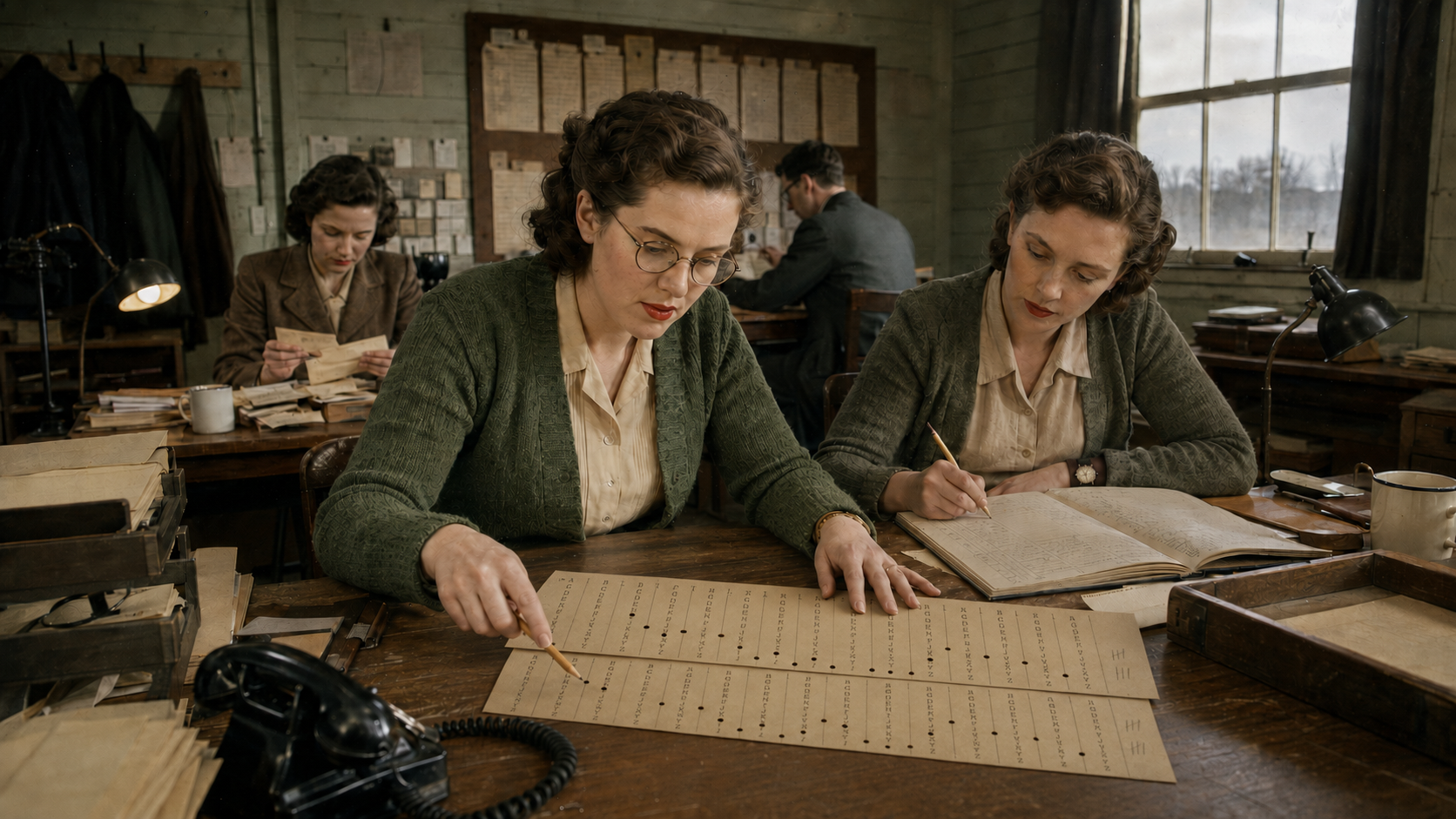
A Bombe could test a hypothesis at speed. It could not decide which of hundreds of possible hypotheses deserved the machine’s scarce hours first.
Joan Clarke could.
Images in this article are generated by

EU AI Act Regulation 2024/1689
Naval Enigma did not present Hut 8 with one locked door. It presented a corridor full of them: different rotor orders, starting positions, plugboard connections, operating procedures and message systems, all changing beneath the pressure of a war at sea. The Bombe was powerful. But it was not clairvoyant.
Before its drums could turn, a cryptanalyst had to narrow the problem. That meant finding structure in fragments: two intercepted messages that might line up, a pattern of letter coincidences, a probable phrase, a procedural mistake, a captured codebook, a weather report that behaved like weather reports usually did. None of those things was necessarily decisive alone. Together, handled carefully, they could become a queue of plausible attacks rather than a haystack with a patriotic label attached.
One of the people exceptionally good at that work was Joan Elisabeth Lowther Clarke. She was a mathematician, a senior member of Hut 8, and one of its longest serving cryptanalysts. The method with which she became particularly associated was Banburismus: Alan Turing’s probabilistic technique for reducing the number of naval Enigma rotor orders that needed to be tested on a Bombe.[1]
It is tempting to describe this as clever people defeating a clever machine. That is only half the story. Banburismus was also queue management under uncertainty. It turned weak evidence into operational priority. In modern security language, it helped decide which alerts deserved expensive investigation before the expensive machinery was set running.
Probability was being used as a scheduling system. Rather more elegant than a red-amber-green spreadsheet, admittedly, but the family resemblance is not hard to discern.
A first without a degree
Clarke arrived at Bletchley Park in June 1940 after studying mathematics at Newnham College, Cambridge. Her results were extraordinary: first-class honours in both parts of the Mathematical Tripos, usually described as a double first, together with the Philippa Fawcett Prize and the Helen Gladstone Scholarship. Cambridge still refused to grant women full degrees; it would not change that rule until 1948. The mathematics was recognised. The mathematician was recognised conditionally. If that sounds outrageous to you then, well, so it should. Cambridge should be thoroughly ashamed of this aspect of its history.
Gordon Welchman, who had supervised some of her geometry work, helped recruit her to the Government Code and Cypher School. Yet she was assigned not to Welchman’s Hut 6, which attacked Army and Air Force Enigma, but to Hut 8, the section led initially by Alan Turing and charged with the harder naval problem.[1][2]
That distinction matters. ‘Bletchley Park codebreaker’ is a useful phrase until it becomes a solvent, dissolving very different targets and methods into one comforting blur. Hut 8 worked on German naval Enigma. Hut 4 translated, interpreted and distributed naval decrypts. Intercept stations supplied the traffic. Bombe sections tested configurations. The Admiralty’s Operational Intelligence Centre decided how intelligence might be used without revealing its source. A break was a chain of work, not a flashbulb moment.
Clarke began in an organisation whose titles and pay scales had not been designed with women mathematicians in mind. That did not make the mathematics less advanced. It made the institution less accurate about who was doing it.
Why naval Enigma was different
The basic Enigma principle was the same one encountered earlier in this series: a keyboard, a lampboard, rotating wired wheels and a plugboard producing a continually changing substitution. The German Navy made the surrounding system considerably less hospitable to attack.
Where the Army and Air Force selected three rotors from a set of five, the Navy eventually selected three from eight. Order matters, so this meant 8 × 7 × 6, or 336 possible rotor orders, rather than 60.[5] That was before considering rotor positions and plugboard settings. Naval operators also used additional indicator and codebook procedures, and their traffic was often short, terse and formula-resistant. U-boats at sea were not generally sending chatty essays with helpful headings. This was a necessary part of their operational security; they revealed their location when transmitting. Their transmissions were nevertheless operationally hazardous: HF communication normally required surfacing, while VLF broadcasts could be received at shallow submerged depth but offered very low data rates. Short messages therefore remained valuable because transmission, particularly transmission back to shore, risked revealing a U-boat’s position.
The Polish mathematicians Marian Rejewski, Jerzy Różycki and Henryk Zygalski had supplied the essential pre-war foundations: reconstructed Enigma logic, methods and working replicas. British attacks built upon that work. But naval Enigma still required its own techniques, helped at crucial moments by captured rotors, indicator books, short-signal books and weather codes. No honest account can remove those dependencies without turning history into a superhero poster, and that is not what this series is about.
The scale of the search created an operational problem. Britain possessed too few Bombes, especially early in the war, to run every conceivable naval job. A method that could reject unlikely rotor orders before machine testing was therefore not a mathematical ornament. It changed what Hut 8 could attempt before the intelligence became stale. Constrained resources required innovative approaches based on “Big Brain” thinking.
Paper with holes in it
Banburismus took its name from the long sheets of paper used in the work, made in Banbury and punched with alphabets representing intercepted ciphertext. The name sounds like a minor English religious dispute. The method was less picturesque and more useful.
Imagine two naval messages that might have been enciphered using the same rotor order. Their precise starting positions are unknown, so one punched sheet is slid against another through a range of possible offsets. At each alignment, the cryptanalyst counts places where the same ciphertext letter appears in both messages.
Why should that tell anyone anything? If the two Enigma streams are brought into the correct relative position, equal ciphertext letters imply equal plaintext letters at those points. Natural language does not distribute letters and letter combinations with perfect randomness. Real German messages therefore produce a slightly different pattern of coincidences from two unrelated strings. The signal is small. Banburismus was designed to extract it without pretending it was certainty.
Matches and mismatches were converted into odds and combined with other comparisons. A single promising alignment might suggest a relationship between message settings; a network of such relationships could make some rotor orders much more credible and rule others out. The survivors were sent towards the Bombes. The losers stopped consuming scarce machine time.
This is the crucial point: Banburismus did not decrypt the message. It reduced the search space. Captured documents did not decrypt the message. They supplied constraints. A crib did not decrypt the message. It supplied a hypothesis. The Bombe did not read German. It tested whether a web of Enigma relationships could hold together. The result emerged from the system.[9]
Joan Clarke at work
Turing devised Banburismus. Hugh Foss was the first to make the difficult method work on an intercepted message, after months of spare-moment effort in 1940. Clarke became one of its most accomplished practitioners and helped turn an ingenious technique into repeatable Hut 8 work.[6]
The surviving descriptions are less cinematic than the achievement. Clarke studied long alphabetical sheets, compared messages, inferred likely relationships and refined methods for shorter signals. She became one of Hut 8’s ‘Seniors’, a small group trusted with difficult cryptanalytic work. English Heritage describes her as the most senior of the section’s few female cryptanalysts and its longest-serving member. In September 1944 she became deputy within Hut 8.[2]
This was not clerical support performed near mathematics. It was mathematics embedded in operations: weighing evidence, choosing comparisons, spotting when an attractive result rested on a weak assumption, and deciding what deserved the next resource. Anyone who has worked in a security operations centre will recognise the mixture of method and judgement. Anyone who has sat through an incident call will recognise how quickly that judgement disappears from the final diagram.
Clarke’s skill also complicates a familiar story about automation. The Bombe did not replace the analyst. It amplified a well-framed attack. Human reasoning reduced the possible world; machinery searched the remainder at a speed no human team could match. Each made the other useful.
A machine may test hypotheses at speed. It cannot rescue an organisation that has queued the wrong hypotheses.
A hut was not a person
Popular memory likes a solitary genius because a solitary genius fits neatly beneath a film poster. Hut 8 did not. It depended on mathematicians, linguists, chess players, classicists, clerical staff, machine operators, teleprinter and communications workers, intercept personnel, translators, indexers, messengers and managers. It also depended on sailors who captured material at terrible risk, and on people elsewhere deciding how to act on a decrypt without advertising that Enigma had been penetrated.
Women were not a decorative minority in that system. By 1945 they made up about three quarters of the nearly 9,000 people working at Bletchley Park. They served as codebreakers, machine and communications operators, translators, traffic analysts, clerical staff and junior or middle managers, while remaining badly under-represented in the highest leadership.[8]
Numbers help, but they can conceal as efficiently as they reveal. Gladys Stephens, who worked in Hut 8 from 1943 to 1945, remembered feeding data into a small machine, waiting for a key to light, writing down the result and sending material through pneumatic tubes. She also remembered three-shift working, awkward billets and compartmentalisation so strict that staff could know very little about the purpose of neighbouring work. Her oral history names Jill Medway, Audrey Atkinson, Christine Ogilvie-Forbes and Patricia Jones among her colleagues. Those names matter because ‘women at Bletchley’ is still a crowd scene. History owes people their edges.[7]
The work was divided for security and scale. The later historical record inherited those divisions, then added secrecy, official anonymity, marriage-related surname changes, unequal titles and a public appetite for famous men beside impressive machines. The hut number remained more visible than many of the people inside it.
Restoring Clarke to the centre must not create a new one-person myth. The correction is not ‘actually, one woman did it’. The correction is that a senior woman cryptanalyst did indispensable work within a large, interdependent intelligence system. Both halves of that sentence are important.
The colleague who became a plot device
Clarke and Turing became close friends and, in 1941, briefly engaged. In a 1992 BBC interview she recalled accepting his proposal and learning the following day about his sexuality. The engagement continued for a time, then ended. Their friendship did not. She was among the first people Turing wrote to after his 1952 arrest and prosecution for homosexual acts.
It is part of both their histories. It is not a licence to turn Clarke into ‘the woman Alan Turing nearly married’, as though her principal contribution to cryptanalysis was appearing in a more famous man’s emotional biography. Nor should it be rewritten as a knowing cover arrangement for which there is no good evidence. It was a relationship between two people who trusted one another inside an institution that needed Turing’s mind while the state criminalised who he was.
Recognising overlooked LGBTQ+ lives does not require inventing identities for the people around them. Turing was gay. Clarke was his colleague, friend and briefly his fiancée; she later married John Kenneth Ronald ‘Jock’ Murray. The honest account can hold all of that without making either person a supporting character in the other’s life.[4]
The broader security lesson is uncomfortable. Organisations often say they need unusual minds while enforcing rules that make unusual people unsafe. Even today, you cannot successfully attract the required unusual people if you turn the simple act of using the toilet facilities that match their presentation into a minefield. Turing’s later prosecution was not merely private tragedy. It was the state damaging one of its own most important security thinkers. Diversity is not a commemorative paragraph added after the clever machinery. It changes who can enter the room, who can stay there and whose judgement the system gets to keep. This lesson is as important today as ever it was.
When the traffic went dark
Banburismus was powerful, but it was conditional. On 1 February 1942 the German Navy introduced the four-rotor M4 Enigma on the Atlantic U-boat network the British called Shark. Hut 8 lost the traffic. For much of that year, the Atlantic messages that mattered most became unreadable again.[2]
This blackout is useful history because it prevents us mistaking a technique for a permanent victory. New equipment, changed procedures and missing key material could invalidate yesterday’s successful workflow. Hut 8 had to study the altered system, build new machinery and exploit fresh captured documents. Codebooks recovered from U-559 in October 1942 were crucial to regaining entry; four-rotor Bombes later made the process more sustainable.[5]
Clarke remained through this change and the later wartime expansion. English Heritage credits her, while studying captured code material, with recognising a relationship between the new fourth rotor and the earlier three-rotor system that assisted work on the problem. The larger point is not that one observation opened every message. It is that recovery came from preserved expertise, new evidence and a willingness to revise the attack.
Modern defenders meet the same pattern with different machinery. A detection that worked yesterday becomes useless when an attacker changes tooling, a cloud service changes its logs, or a team changes an authentication flow. Resilience is not owning a celebrated analytic. It is retaining people who understand why it worked, what assumptions it made and how to rebuild when those assumptions fail.
Banburismus in a modern security team
The closest modern descendant of Banburismus is not one product. It is the reasoning that sits between raw evidence and expensive action.
A security team may receive millions of events, thousands of alerts and dozens of plausible incident stories. It cannot reverse-engineer every binary, detonate every attachment, acquire every disk image or wake every specialist. It assigns weights: this domain is newly registered; that account logged in from an unfamiliar device; this process tree is rare; the same infrastructure appeared in a previous intrusion; the supposed invoice arrived three minutes after a password reset.
No single clue proves compromise. Combined carefully, they change the odds. Good threat hunting, fraud detection and incident triage all use this principle, whether the scoring is formal Bayesian inference or an experienced analyst’s disciplined judgement. The work is to reduce a vast possibility space without discarding the truth merely because it arrived looking untidy.
There are three cautions. First, a score is not reality. It expresses assumptions about evidence, and attackers delight in stale assumptions. Second, correlations are not independent simply because the dashboard displays them in separate boxes. Counting the same underlying event three times is not more intelligence; it is confidence laundering. Third, prioritisation systems inherit institutional bias. If analysts, languages, regions, identities or threat models are systematically overlooked, the queue will look mathematically calm while being operationally wrong.
Clarke’s work therefore points to something more useful than ‘use AI to find patterns’. Preserve the chain from evidence to hypothesis. Record why alternatives were rejected. Calibrate confidence against outcomes. Let humans challenge the model. Protect the quiet specialists who notice when the data no longer behaves as expected. And make sure credit follows the work closely enough that expertise does not vanish when its owner leaves.
What the record chose to say
In January 1946 Clarke was appointed MBE. The London Gazette did not say ‘for senior cryptanalysis against German naval Enigma’. It listed ‘Miss Joan Elisabeth Lowther CLARKE’ as ‘Employed in a Department of the Foreign Office’. The phrasing was required by secrecy. It was also an extremely efficient way to make exceptional work look like filing.[3]
She continued in signals intelligence after the war, married Jock Murray in 1952, and returned to GCHQ in 1962 after a period away. She later helped the historian Harry Hinsley correct an inaccurate account of the respective British, French and Polish contributions to the Enigma story. That detail feels entirely in character: the evidence mattered, including evidence that redistributed credit.[1]
Clarke also became a respected numismatist. Her work on medieval Scottish coinage again relied on exact observation, classification and the recognition of patterns other scholars had missed. In 1986 the British Numismatic Society awarded her its Sanford Saltus Gold Medal. A life may have a method running through it even when the material changes from punched ciphertext to worn silver.[10]
She died in 1996, after decades in which official secrecy made full public recognition almost impossible. Secrecy explains some of the absence. Sexism explains more. Later storytelling added another distortion by treating technical women as novelties, assistants, romantic interests or inspirational exceptions rather than professionals with colleagues, methods and authority.
The security history habit of placing one man, one machine and one flash of genius beneath a convenient desk lamp is not an audit trail. It is branding.
The artefact
The tempting artefact for this chapter would be another Enigma machine or a gleaming Bombe. Both are marvellous objects. Both attract the eye so efficiently that the judgement around them can disappear.
A better artefact is a Banbury sheet: long paper, alphabets, holes, alignment marks and the residue of comparison. It looks unimpressive because inference often does. There is no spinning rotor to demonstrate, only evidence being moved into a relationship where it can say slightly more than it said before.
That sheet carries several histories at once. It carries Turing’s probabilistic method, Foss’s first successful application, Clarke’s sustained skill, the intercepted labour that supplied the letters, the captured documents that constrained the problem, and the Bombes waiting for a better question. It is the interface between human judgement and mechanised search.
Most of all, it corrects the direction of the usual gaze. Do not look past Joan Clarke to see the machine. Look at the machine after Joan Clarke has decided what it should do.
Before intelligence could leave Hut 8, intelligence had to be exercised inside it. Joan Clarke did that work.

00010011 DC3
Source notes
The article uses cautious attributions where surviving summaries differ. In particular, Clarke is described as an outstanding practitioner of Banburismus, not its inventor, and the MBE date follows the official Gazette notice.
References & Links
[1] GCHQ, ‘Joan Clarke’ – recruitment, Hut 8, Banburismus, friendship with Turing, post-war service and work with Harry Hinsley. https://www.gchq.gov.uk/person/joan-clarke
[2] English Heritage, ‘Joan Clarke’ – Cambridge honours, seniority in Hut 8, deputy role, M4 work and later career. https://www.english-heritage.org.uk/visit/blue-plaques/joan-clarke/
[3] The London Gazette, Supplement 37412, 9 January 1946, p. 290 – official MBE listing. https://www.thegazette.co.uk/London/issue/37412/supplement/290/data.pdf
[4] BBC Horizon, ‘The Strange Life and Death of Dr Turing’ (1992), transcript – Clarke’s own recollection of the engagement and Turing’s disclosure. http://bam.files.bbci.co.uk/bam/live/content/zgfr9j6/transcript
[5] Ralph Erskine, ‘Breaking Naval Enigma (Dolphin and Shark)’, Bletchley Park / Historical Mathematics and Cryptology – naval procedures, captures, Banburismus, Bombes and M4 chronology. https://cryptocellar.org/bgac/hmtr-2066-2.pdf
[6] Bletchley Park, ‘Hugh Foss’ – Turing’s invention of Banburismus, Banbury paper and Foss’s first successful application. https://bletchleypark.org.uk/wp-content/uploads/record_attachments/1937.pdf
[7] Bletchley Park Oral Histories, Gladys Stephens – first-person account of Hut 8 machine work, shifts, pneumatic tubes and named colleagues. https://bletchleypark.org.uk/wp-content/uploads/record_attachments/178.pdf
[8] Bletchley Park Trust, institutional overview (2024) – workforce scale and the proportion and range of women’s wartime roles. https://bletchleypark.org.uk/wp-content/uploads/2024/10/Bletchley-Park-announces-new-Chair-of-the-Board-of-Trustees-FINAL.pdf
[9] Alan Turing, ‘The Applications of the Enigma’, Chapter VI – contemporary technical context for Bombes, cribs and naval Banburismus. https://www.ugr.es/~aquiran/cripto/museo/turing/turchap6.pdf
[10] Lord Stewartby, ‘Joan E. L. Murray’, British Numismatic Journal 67 (1997) – obituary and account of Clarke’s numismatic career.
https://www.britnumsoc.org/publications/Digital%20BNJ/pdfs/1997_BNJ_67_13.pdf

