
“Many Caesars in a Trench Coat”
Al-Kindī taught the attacker to count.
The Vigenère cipher replies: fine, count this.
A simple substitution cipher has one fatal habit: each plaintext letter keeps turning into the same ciphertext letter.
Images in this article are generated by

EU AI Act Regulation 2024/1689
That is very considerate of it, in the way a burglar leaving a forwarding address would be considerate. Frequency analysis notices the pattern and uses language against the cipher.
The obvious defence is to stop using just one alphabet.
That is the elegant idea behind the Vigenère-style cipher. Instead of shifting every letter by the same amount, as in Caesar, it uses a sequence of shifts. One letter may be moved by eleven places, the next by four, the next by twelve, depending on the keyword. The same plaintext letter can therefore become different ciphertext letters in different positions. Simples!
The language is still there, but it has been made to change masks.
Suppose the plaintext is:
ATTACKATDAWN
and the keyword is:
LEMON
Repeat the keyword until it matches the length of the message:
LEMONLEMONLE
Now use each key letter to choose a Caesar-style shift, counting A as 0. The first plaintext letter A is shifted by 11, because L is the 12th letter of the alphabet. The second, T, is shifted by 4, because E is the 5th. The third, T, is shifted by 12, because M is the 13th. Continue like that and the ciphertext becomes:
LXFOPVEFRNHR
This is the sort of example that appears in cryptography introductions because it is compact, memorable, and avoids the usual academic habit of making examples about Alice, Bob, Eve, Mallory, and Trent until everyone involved loses the will to alphabet.
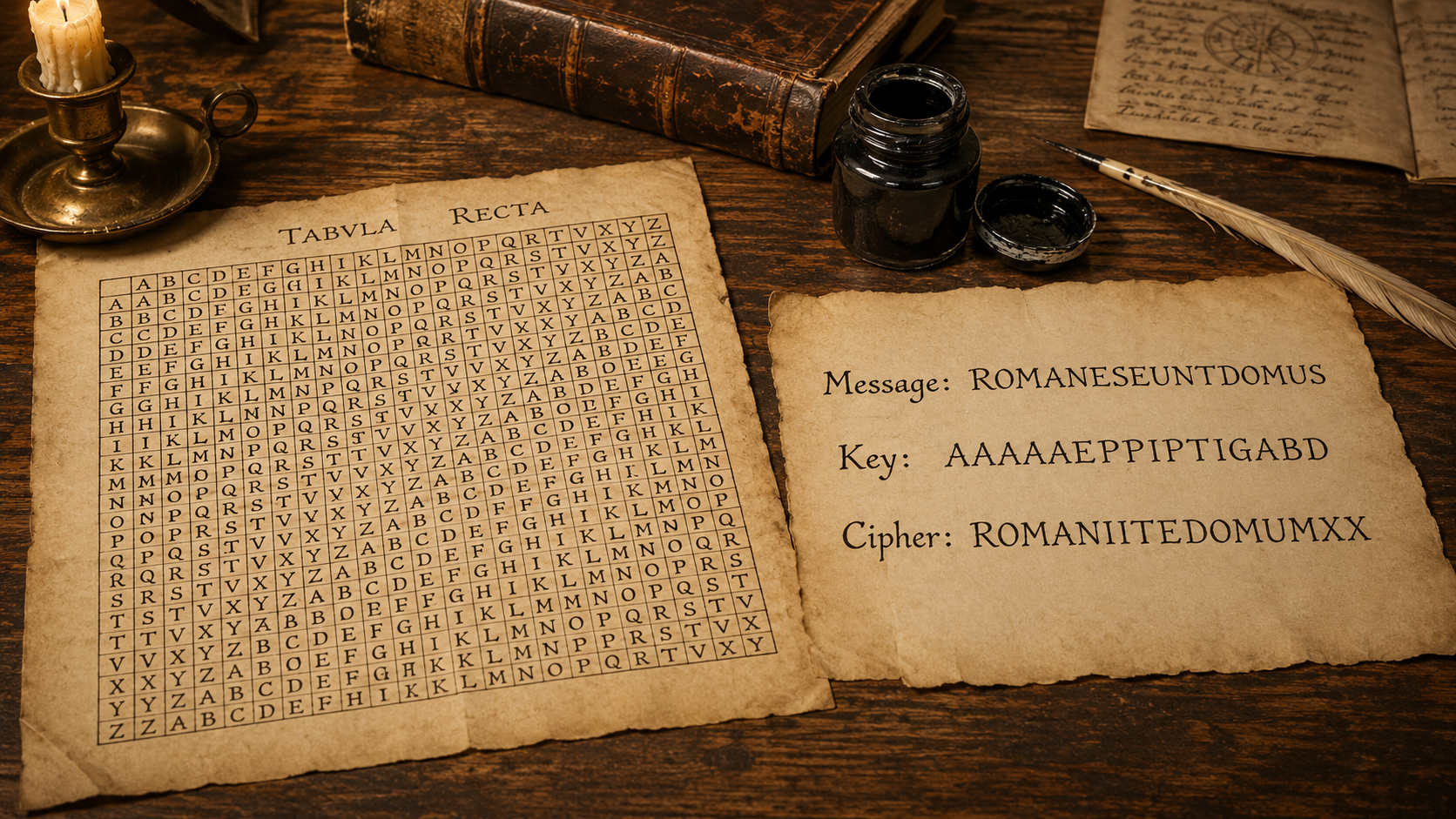
The mechanism is not hard to understand. The usual tool is a tabula recta, or Vigenère square: a table of shifted alphabets. Pick the row using the key letter, pick the column using the plaintext letter, and the intersection gives the ciphertext. To decrypt, reverse the process. It is several Caesar ciphers taking turns.
Many Caesars in a trench coat, basically.
The attraction is obvious. In a Caesar cipher, if E becomes H once, E becomes H every time. In Vigenère, E might become P in one position, I in another, and E somewhere else. Straightforward frequency analysis is disrupted. The most common ciphertext letter no longer maps cleanly to the most common plaintext letter. Al-Kindī’s counting attack has not vanished, but it has been made to work much harder.
For a long time, that felt like magic. The Vigenère cipher became associated with the phrase le chiffre indéchiffrable: the indecipherable cipher. It was not indecipherable, naturally. Few things are, and most of them are only waiting for enough ciphertext, enough mathematics, enough incentive, or enough government funding.
But before we give the cipher its marching orders, we have to deal with the name.
The cipher now usually called the Vigenère cipher is not, in the simple repeated-key form, really Vigenère’s invention. Giovan Battista Bellaso described a closely related and historically central method in his 1553 work La cifra del Sig. Giovan Battista Bellaso. Blaise de Vigenère, a French diplomat and scholar, later published Traicté des chiffres, ou Secretes manières d’escrire in 1586 and described important cipher systems, including an autokey approach. The name “Vigenère cipher” stuck later, because historical credit is lazy.[1]
This does not mean Vigenère was irrelevant. He was a serious cryptographic writer, and his autokey idea was stronger than the simple repeating-key system that now carries his name. The correction is not “Vigenère bad, Bellaso good”. That would be a childish swap of one statue for another. The better correction is: Bellaso deserves far more credit for the cipher commonly bearing Vigenère’s name, and Vigenère deserves credit for his own actual work rather than someone else’s simplified legacy.
The prehistory matters too. Leon Battista Alberti had described polyalphabetic ideas in the fifteenth century, using a cipher disk. Johannes Trithemius developed the tabula recta in the early sixteenth century. Bellaso’s importance was in using an agreed keyword, or countersign, to select the changing alphabets. These are not isolated sparks. They are a line of people trying to solve the same problem: how do you stop language from giving itself away?
The answer, for a while, was: change alphabets repeatedly.
The failure, eventually, was: the repeated key.
That is the whole tragedy in miniature. The Vigenère cipher is strong enough to defeat the obvious attack, but its ordinary form depends on a keyword that is usually much shorter than the message. The keyword therefore repeats. Repetition creates rhythm. Rhythm creates evidence. Evidence makes cryptanalysts happy, and nobody wants that.
The breakthrough attack is usually associated with Friedrich Kasiski, a German military officer who published Die Geheimschriften und die Dechiffrir-Kunst in 1863.[4] Charles Babbage appears to have used a similar method earlier, but did not publish it, which is a shame.[2]
Kasiski’s idea is beautifully annoying.
If a repeated plaintext fragment happens to be encrypted under the same part of the repeated key, it will produce a repeated ciphertext fragment. Measure the distance between those repeated ciphertext fragments. That distance is likely to be a multiple of the key length. Find enough repetitions, compare their distances, look for common factors, and the key length tends to emerge from the fog.[3]
Once the key length is known, the grand “indecipherable” cipher starts coming apart into smaller, more familiar pieces.
Imagine the key is five letters long. Take every fifth ciphertext letter: those letters were all encrypted using the same key letter, meaning the same Caesar-style shift. Do the same for the next column, and the next, and the next. The mighty polyalphabetic cipher becomes five separate frequency-analysis problems.
Al-Kindī returns through the back door, holding a tally sheet. He hadn’t left, merely popped out for lunch[5].
This is why Vigenère belongs in a cybersecurity history, not merely a cryptography timeline. It shows a recurring pattern: a defence is built specifically to defeat a known attack, but the implementation leaves a new structure behind. The attacker stops attacking the old weakness and starts attacking the new one. Security advances, then analysis advances, then everyone involved writes longer procedures and pretends this was the plan.
The cipher also gives us a clear early warning about key streams. In modern terms, the repeated keyword behaves like a small, predictable key stream stretched across a larger message. That should make the back of your neck itch. A good key stream should not repeat. It should not be guessable. It should not be reused. It should not be shorter than the thing it is protecting and then looped optimistically while whistling nervously.
That idea will reappear later in this series with the Vernam cipher and the one-time pad. If the key stream is truly random, secret, used once, and as long as the message, you get something extraordinary. If it repeats, you get evidence. Vigenère is the ghost of the one-time pad before the necessary operational conditions were understood properly.
It is tempting to mock the repeated-key Vigenère cipher for being breakable. We should resist doing so too much. For its time (the actual context), it was genuinely clever. It addressed a real weakness in monoalphabetic substitution. It complicated casual and even skilled attack. It made cryptanalysis harder. That matters.
But it also teaches the next lesson.
A cipher can be mathematically more sophisticated and still operationally fragile. A longer-looking secret may not be a better secret. A keyword that users can remember may be too short. A keyword shared between correspondents may be reused. A system that looks strong on a clean page may become weak in real correspondence, with real messages, real habits, repeated openings, predictable subjects and tired people doing security under pressure.
There is also an attribution story here, and it is unusually blatant.
The name “Vigenère cipher” itself is a credit leak. Bellaso’s role has been pushed into the footnotes of popular memory, while Vigenère’s name labels the classroom version. It matters because historical naming shapes who looks important.
The Vigenère cipher defeated simple frequency analysis by refusing to be one alphabet.
It failed because the key repeated.
The defence became a rhythm. The rhythm became a clue.
Which is clever, fragile, and still rather familiar.

00000100 EOT
References
[1] Encyclopaedia Britannica, “Vigenère cipher”, for the general mechanism, Bellaso/Vigenère attribution, le chiffre indéchiffrable, and the repeated-key weakness. (Encyclopedia Britannica)
[2] Blaise de Vigenère, Traicté des chiffres, ou Secretes manières d’escrire, 1586, digitised by the Bibliothèque nationale de France through Gallica. Useful as the primary-source anchor for Vigenère’s actual work. (Gallica)
[3] Michigan Technological University, “Kasiski’s Method”, for the explanation of Kasiski’s 1863 publication, Babbage’s earlier unpublished use, repeated fragments, distance measurement and key-length inference. (MTU Knowledge Base)
[4] Friedrich W. Kasiski, Die Geheimschriften und die Dechiffrir-Kunst, 1863, bibliographic record and digitised copy trail via Google Books. (Google Books)
[5] A Caesar Salad, maybe. (I’ll get my coat).

