
“When the Key Was a Stick”
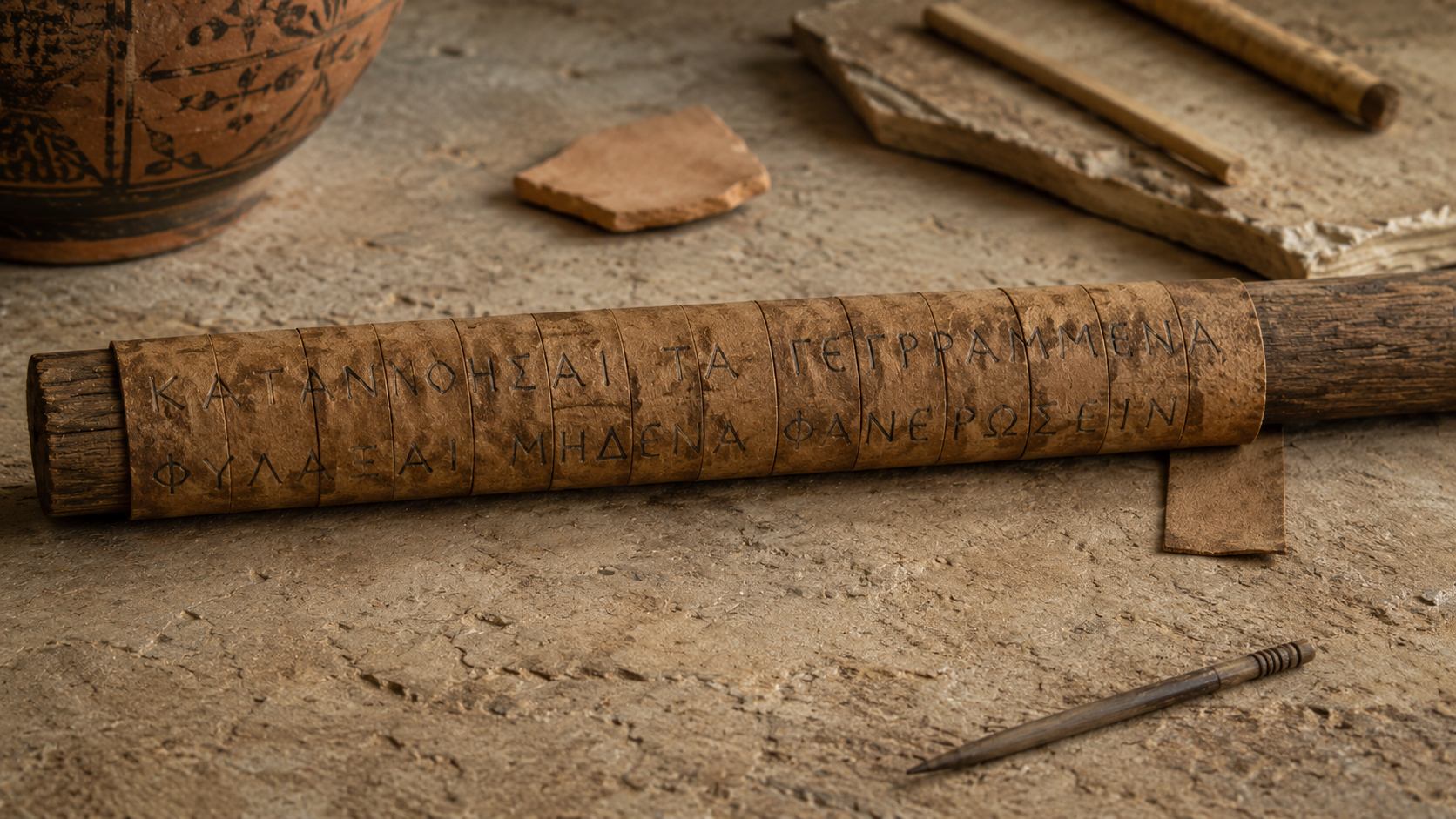
Imagine stopping a courier on a dusty road and finding, tucked among the ordinary business of war and politics, a narrow strip of leather covered in letters. Not sealed in a vault. Not protected by a password policy written by someone who hates both users and language. Just a strip. You can hold it. You can see the marks. You may even know the language.
Images in this article are generated by

EU AI Act Regulation 2024/1689
And yet you cannot read it.
That is the quiet little trick of the scytale. The message is present, but the meaning is not. To recover the meaning, you need the right staff.
The scytale, usually associated with ancient Sparta, was a cipher device made from a staff and a strip of writing material. The sender wrapped the strip around the staff, wrote the message along it, then unwound the strip and sent only the strip. Once unwound, the letters appeared in the wrong order. The recipient, with a staff of matching size, wrapped the strip back around it and the message lined up again. Plutarch gives a clear version of this mechanism in his Life of Lysander: without the matching scytale, the received letters have “no connection” and are “disarranged”; wrapped around the correct staff, the continuity of the message returns[1].
That makes the scytale a lovely opening artefact for a history of cybersecurity. Not because it was frighteningly strong. It was not. This is not AES in sandals. Its importance is more subtle: it frames security as authorised reading.
The strip is data. The staff is context. Possession changes meaning.
That idea is still with us. A smartcard, a hardware security module, a FIDO key, a device-bound passkey, a key ceremony, even a sealed envelope in a safe: all are descendants of the same broad thought. The secret is not always hidden in the message itself. Sometimes it is hidden in the conditions under which the message becomes usable.
The scytale is commonly linked to Spartan military communication, particularly messages between the ephors, senior Spartan magistrates, and commanders away from home. One story concerns Lysander, a Spartan commander, receiving a scytale message from the ephors after complaints from the Persian statesman Pharnabazus. The message mattered because it carried authority across distance. It was not merely private chat. It was command, discipline and political control travelling as a strip of text.[2]
This is where the artefact becomes more than a cipher toy. The scytale sits in a system. Someone must make the staff. Someone must cut or prepare the strip. Someone must write the message correctly. Someone must carry it. Someone must decide who gets a matching staff and who does not. Someone must notice if the courier is late, captured, bribed, drunk, ambitious, terrified, or simply human. Cryptography is rarely just cryptography, which is inconvenient for people who want clean diagrams and no messy sociology. Plus ça change, plus c’est la même chose.
There are also some important historical caveats. The clearest surviving descriptions of how the scytale worked come from authors writing centuries after the period in which Spartans are thought to have used it. Plutarch and Aulus Gellius are both useful, but they are not CCTV footage from the fifth century BCE. There is no surviving physical scytale proving exactly how the system was used in practice. Modern historians have therefore argued about whether it was really a practical encryption device, a message-authentication device, a badge of authority, or a tradition later made neater by writers who liked a good story. Martine Diepenbroek’s modern reassessment is particularly useful because it challenges the habit of dismissing the scytale as too simple to have been useful[3].
The weakness is easy enough to see. A scytale rearranges letters; it does not disguise the letters themselves. In modern terms, it is a transposition system, not a substitution system. If an attacker suspects the method, they can try wrapping the strip around staves of different diameters, or reconstruct the text as grids of different widths, looking for words to reappear. There are only so many plausible sizes before the exercise becomes less “mystical codebreaking” and more “annoying craft project”.
It also leaks plenty. The strip tells an interceptor that a message exists. Its length tells them something. The courier route tells them something. The sender and recipient, if known, tell them something. The scytale hides content, not metadata, provenance or intent. Ancient commanders had the same problem as modern security teams: the thing you protected was not the only thing you were leaking.
Nor does the scytale automatically solve integrity. If an enemy can read the message, copy the wrapping, or obtain a matching staff, they may be able to forge or alter messages. That pushes us towards another recognisably modern lesson: confidentiality is not the same as authenticity. A message can be secret and still not be trustworthy. Future artefacts in this series will return to that point repeatedly.
The attribution story is also worth pausing over. Ancient accounts tend to name elite men: magistrates, generals, writers, statesmen. The “Spartans” used the scytale, we say, as if an entire society were a single bearded statue holding a spear and looking pleased with itself.
But operational systems are never made only by the people who get named.
Who prepared the strips? Who made the rods? Who trained messengers? Who carried the messages through hostile territory? Who maintained the bureaucratic habits that made the thing usable? What non-citizen, enslaved, helot, servant or craft labour sat underneath the Spartan military machine? The evidence does not let us confidently name those people. That is the point. Their absence from the record is not evidence that they did not matter. It is evidence that the record was made by people who were comfortable forgetting them.
We should also avoid making this a tidy “Western invention” story. Secret communication is much older and broader than one Greek device, and the scytale story itself involves Persians, Spartans, inter-state pressure, military violence and political authority. Pharnabazus is not scenery. He is part of the pressure that makes the communication matter. The wider world is not a decorative border around Greek cleverness.
So why begin here?
Because the scytale gives us, in one satisfyingly physical object, several ideas that still define cybersecurity. A key must be shared. A channel may be intercepted. A readable message is not the same as a visible message. A system depends on people and procedures. Security claims must be judged against adversaries, not vibes. And a mechanism that looks clever in the hands of authorised users may look quite different in the hands of someone patient, hostile and well supplied with sticks.
The scytale is not impressive because it was unbreakable. It is impressive because it shows how early the security problem becomes recognisable.
Someone has a message. Someone else wants to read it. The sender has assumptions. The adversary has time. The courier has a bad day. The system has edges.
Cybersecurity begins there: not with silicon, not with software, not with a vendor webinar full of annoying rectangles, but with the ancient and persistent question of who is allowed to understand what.
In this case, the answer was: the person with the right stick.
Which is ridiculous, elegant and uncomfortably modern.

00000001 SOH
References
[1] Plutarch, Life of Lysander, for the classic description of the strip being unreadable until wrapped around the matching scytale. (lexundria.com)
[2] Martine Diepenbroek, “Ancient Cybersecurity? Deciphering the Spartan Scytale”, for an accessible modern discussion of sources, mechanics, Spartan context and caveats. (Antigone)
[3] Martine L. M. Diepenbroek, Myths and Histories of the Spartan Scytale, University of Bristol PhD thesis, for the deeper reassessment of the scytale’s status as a practical cryptographic device. (University of Bristol)

