

The “taking back control” aspect of Brexit is, and always was, a load of codswallop1. However, I’d be churlish to deny that it does indeed open up new opportunities…. for the EU, that is.
English has an unusual position as languages go. And, despite the UK’s departure from the EU, it remains an official EU language because English is an official language in Cyprus, Malta, and Ireland.
“English is a difficult language”, the saying goes, “it can be mastered through tough thorough thought though” – thereby illustrating one of its major problems: irregularity and sheer complexity.
One only has to flick through a Thesaurus2 to find how many similar-meaning words are available… but each with subtleties in their usage sufficient to confuse even many native speakers. English has absorbed so many different language fragments from so many different places (and invaders!) that it is, perhaps, hardly surprising that it is a bit of an idiosyncratic & eccentric language.
But now the UK is no longer at the EU table, and the EU is free to define Standard Eurpoean English with no opportunity for the UK to object3. Finally, maybe, something like the concept of Esperanto4 could actually be realised.
“But you can’t do that to the language of Shakespeare” I hear (some of you) cry. Verily art thou jesting, nave? We don’t speak the “language of Shakespeare” in everyday usage any more. The plays can stay as they are.
Here’s where I would start: Verbs!
English Verbs
One of the great things about English is that any noun can be verbed
In some languages, such as Romanian, the personal pronouns are rarely used or required because the verb declension directly implies the 1st/2nd/3rd person singular/plural forms with only slight ambiguity. In English the opposite it true; for many verbs it is only the 3rd person singular for that differs from all the others5.
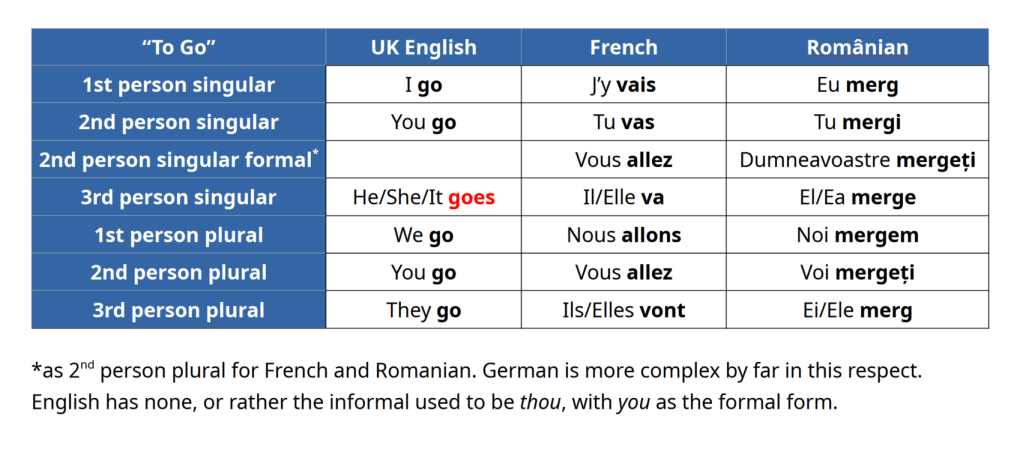
So with just a couple of changes, we simplify and improved the lives of everyone needing or wishing to learn English as a non-primary language; we remove the irregularity of the 3rd person singular form, and remove the ambiguity in plurality of the 2nd person forms. And, hey presto, it suddenly looks more like the “language of Shakespeare” than before! The personal pronouns are always required, since the verb form doesn’t change.

And again with the irregular verb to be:

Conclusions
Many aspects of English could be made regular and logical. It would cement, maybe permanently, this form of English as a standard universal non-primary language for non-native English speakers. It would, with the application of some big-brain thinking, hugely simplify the task of learning English as an additional language. Important, really, since the English are so lackadaisical when it comes to learning any other languages themselves.
So will we ever see Standard European English? I don’t really know. But, and this is the key point, whether we do or not is outwith the control of the UK now; the EU is a sufficiently large bloc to have its standards recognised worldwide and, in some cases, so adopted.
But if it does come to pass…. You read it here first, from Sophie!

Footnotes
- OED: Nonsense, rubbish, drivel. Often in a load of (old) codswallop. ↩︎
- But never a decent alternative word for “thesaurus” I note with grim irony. ↩︎
- Well, technically we can object until we are blue in the face. But our objections will carry no weight whatsoever. Now that’s what I call “taking back control”… by the EU, that is. ↩︎
- The only language I know of with its own flag, despite being the native language in zero countries:
 ↩︎
↩︎ - Ignoring of course the most irregular English verb best captured by Bernard Woolley in Yes, Minister ↩︎
“That’s one of those irregular verbs, isn’t it? I give confidential security briefings. You leak. He has been charged under section 2a of the Official Secrets Act.”
Bernard Woolley, “Yes, Minister” BBC, 1980s
 Sophie Baskerville
2 responses to “Standard European English”
Your use of the word “outwith” in the penultimate paragraph is interesting. Meaning “outside”, the word is seldom found outwith Scotland.
LikeLike
One of the observations I saw about the word “outwith” read: “If you have ever said it around a non-Scot, you likely will have been met with a confused reaction”. Challenge accepted, how could I resist? 🤭
What were those BBC Reithian Principles? Inform, Educate and Entertain – I’d call that 3 out of 3!
LikeLike