
If you’re a man with a female partner, then when you’ve read this article ask them to read it too and see what their reaction to it is.
If you’re a woman with a male partner, then when you’ve read this article ask them to read it too and see what their reaction is.

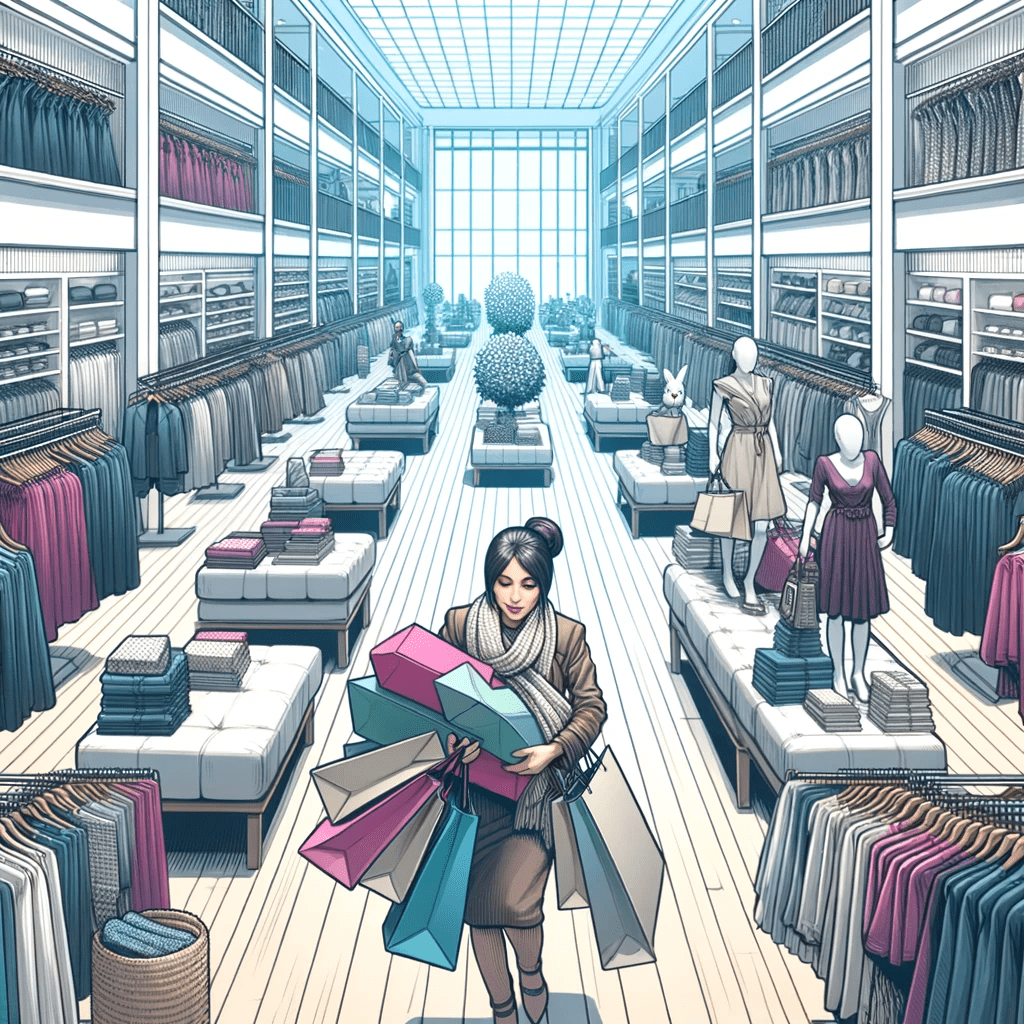
Boy-mode cf Girl-mode
Spending time in each mode provides me with insight which I don’t think I could have acquired any other way. I’ve always regarded myself as an enlightened 20th Century Man, and been proud of my ability to empathise with the trials and tribulations of the other 50%1 of the population.
Boy,2 was I naïve!
Let’s talk about clothes & clothes shopping.
In boy-mode, it’s easy. For an office, a suit. I prefer to leave the jacket behind these days, but wear a waistcoat so that it still looks like a suit. Also, that’s a slightly old-fashioned look, commensurate with my age. If I turn up and someone else is wearing a suit… Well that happens all the time and nothing is thought of it. The only times a suit gets commented upon are if it is a very expensive designer one (of which I have, having counted them twice carefully, precisely none), when someone who doesn’t normally wear one wears one (“Did the judge let you off then?”), or if it is a truly extrordinary one – white, or bright green/yellow/red.
Office clothing may also be smart casual, but requires equally little effort or thought.
Out of work, jeans & tshirt, zero thought required.
Then there is girl-mode. I’m occasionally going into an office in girl-mode now; it’s only my 7th such day, and I’ve had to put together a 7th outfit for today. There’s no written rule, but I just feel unable to turn up in something I’ve already worn too recently (like within the last few weeks). And it would be truly horrifying to turn up wearing the same as someone else. No one has told me these “rules”, but they seem to just exist. It wasn’t something that I was expecting.
After my first day in the office in girl-mode, a Friday, which was less scary and a lot more relaxing than I had expected, I decided to repeat the experience on the Monday – but realised that I had only one long dress, since when Sophie parties, she tends towards the short or even shorter style ones. So I found myself buying a suitable dress over the weekend. Then 4 more later in the week – two of which I simply could not choose between, so bought both. And now I have worn all of them except one, which is there as a reserve in case I can’t come up with anything new one morning.
It’s societal pressure; women are expected to look good, all the time every time, and to magic up new outfits from nowhere.
And yet, at the same time, endless jokes are cracked about how much women like to shop, how many clothes they have, and how many shoes/boots they have. To conform, to deal with the societal pressure, to comply with the unwritten rules – women actually need them. Maybe not as many shoes as the 3000 pair Imelda Marcos had, but more by far than anyone presenting as male is likely to need.
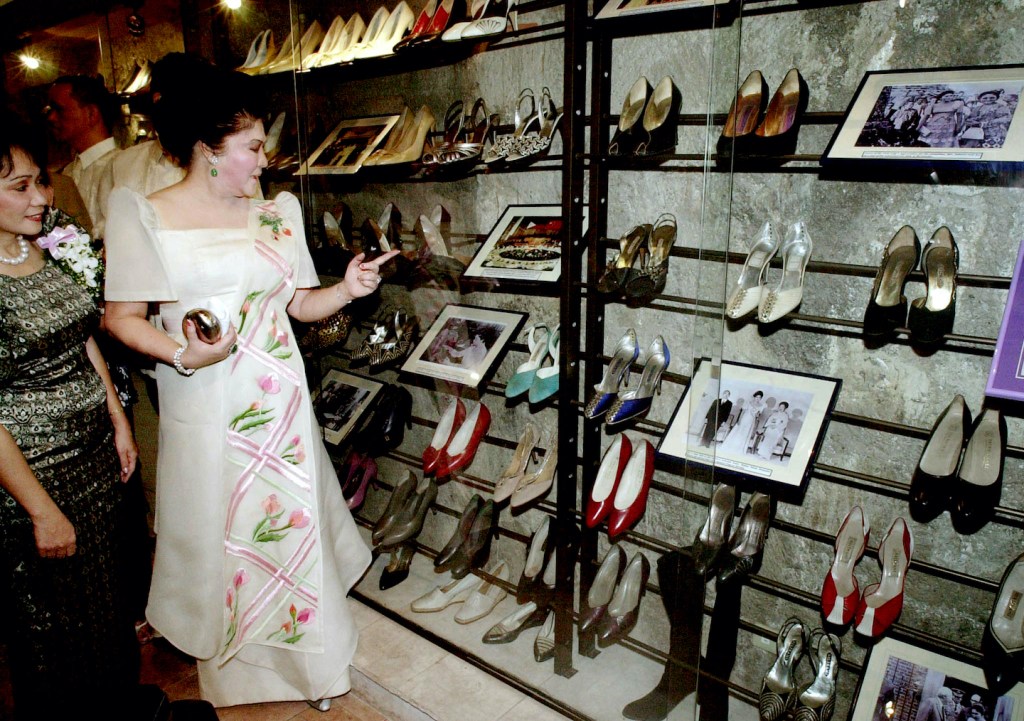
“Democracy is the right to shoes”
Society needs a bit of a reality check: you can’t: you can’t expect certain behaviours, then deride those same behaviours. At least, not without being terribly unfair.
The pressure is there, and it is real. And it impacts women young and old. And the pressure can be so high, particularly on young women – high enough to cause unhappiness, body image problems, and mental health issues.
“Reality Cheque” (Love a bad joke), imagined by DALL-E
On one of my office days I walked to some shops at lunchtime. I didn’t realise how terribly dangerous this could be, from a clothes shopping perspective.
I tried on a rather nice jacket, finding they had a size which fitted me, and realised that it would go well with lots of different outfits. Boom! Purchased before I knew it. It can be so difficult to find something you like which actually fits – especially if you don’t match the manufacturers’ idea of average.
Today’s British women3 are 165cm (5′ 5″) tall on average, weigh 70kg (11st), have size 39 feet (UK size 6) and dress size 16. Yet many clothing brands consider size 16 to be “Large”, with “Medium” being 10-12. I’ll call out Boohoo here, in a good way, for simply using the size numbers and not labelling them as small or medium or large. Even M&S uses these s/m/l designations, although their sizes tend to be +2 cf the number written on them, which helps a little maybe. But what’s wrong with the number by itself?

This cute little jacket makes a key piece of clothing for me – it can be worn with or without the faux-fur, open or closed, and if it is raining it and its hood are waterproof – the latter important for keeping my hair dry. I’ve tried short hair and I don’t like it, but long hair is so complex. Complex enough dry, but horrendously complex wet!
This is a type of unplanned purchasing I’m simply not used to but find myself doing in girl-mode.
Luckily I have been given some rather nice & rather expensive dresses etc to try on before passing any unsuitable or non-fitting items on to a clothing charity shop. In the nick of time, frankly, because I need to be planning my next seven outfits ready.
Something is rotten….
Of course, not all women do comply with the unwritten rules and general expectations of society. And there is nothing wrong with that at all. What is wrong is the way society (ie us!) react to that – the descriptions which get applied (frumpy, dowdy, and much much worse) are not pleasant, and yet the other half of the population seems to live (in this area, and others) in a rule-free & judgement-free environment.
Equality is more than equal opportuities. Equivalent rules are necessary too – whether written or unwritten. And, of course, it is the unwritten ones which are difficult to tackle. Society needs to become less judgemental of half of the population. Our children and grandchildren cannot grow up in a society of equals if half of them are judged by different standards and different rules.
The changes necessary are non-trivial. And should start with each one of us.

Closing Thoughts
So next time you are about to comment upon quantity of clothing or shoes a woman has, or comment about their clothes shopping… Stop. Think. Does she literally have more shoes than Imelda Marcos? If not, maybe just remember that she is doing her best to meet the expectations of society, and that this is difficult enough without being undermined by that same society for so doing.

Footnotes
- Well, more like the other ~48.9%. If we remove the ~1.7% intersex population, that give ~49.4% male and ~48.9% female.
But that’s not valid either; many if not most of the intersex individuals will present to the outside world as either male or female, and thus be subjected to societal pressures as per their presentation.
And some of the 48.9% will actually present as male, along with some of the 49.4% who will actually present as female, and thus be subjected to societal pressures as per their presentations.
I couldn’t even find a figure for percentages of the population presenting as male or female or non-binary; ChatGPT helpfully had this to say on the matter:
“Determining the global percentage of people who present themselves as male, female, or non-binary is challenging due to the lack of comprehensive global data on gender identity beyond the traditional male and female categories. Most demographic data classifies people based on their sex assigned at birth. Non-binary and other gender identities are increasingly recognized, but statistical data on these populations are not widely available on a global scale. National surveys in some countries have started to include options for non-binary and other gender identities, but this data is not yet broadly represented in global statistics.”
Which just hightlights how very complex gender is, even without anyone trying to grind a political axe.
↩︎ - See what I did there? 🤭
↩︎ - March 2017 article in The Independent looking at changes since 1957 ↩︎
 Sophie Baskerville